Kim Jeong-hui
1786–1856 · Joseon · Joseon period art, Calligraphy, Epigraphy, Ink painting
The story
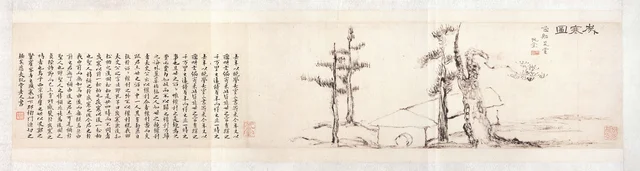
In 1844, on Jeju Island, an exiled scholar painted a bare little house between old pine trees and wrote a long note beside it. Kim Jeong-hui, known by his pen name Chusa, had been banished there in 1840 after a political struggle at the Joseon court. His pupil Yi Sang-jeok, an interpreter who travelled with embassies to Beijing, kept sending him rare Chinese books, and the painting, Sehando, was his thanks. The title comes from Confucius, who said that only when the year turns cold do we see that pine and cypress are the last to wither.
Kim was above all a calligrapher and epigrapher. As a young man he went to Beijing with his father and met leading Qing scholars such as Weng Fanggang and Ruan Yuan, and he later identified an old stone on Mount Bukhan as a monument of King Jinheung, a 6th-century ruler of Silla. From ancient inscriptions he built his own angular script, still called the Chusa style.
Yi took Sehando to Beijing, where 16 Chinese scholars added poems and comments, turning it into a long scroll. In the 20th century it passed to the Japanese scholar Fujitsuka Chikashi, who took it to Japan. In 1944 the Korean calligrapher Sohn Jae-hyeong spent about two months in Tokyo persuading him to give it up, and a few months later air raids burned most of Fujitsuka's library. In 2020 the collector Sohn Chang-keun gave Sehando to the National Museum of Korea.