Kolë Idromeno
1860–1939 · Albania, Ottoman Empire · Realism
The story
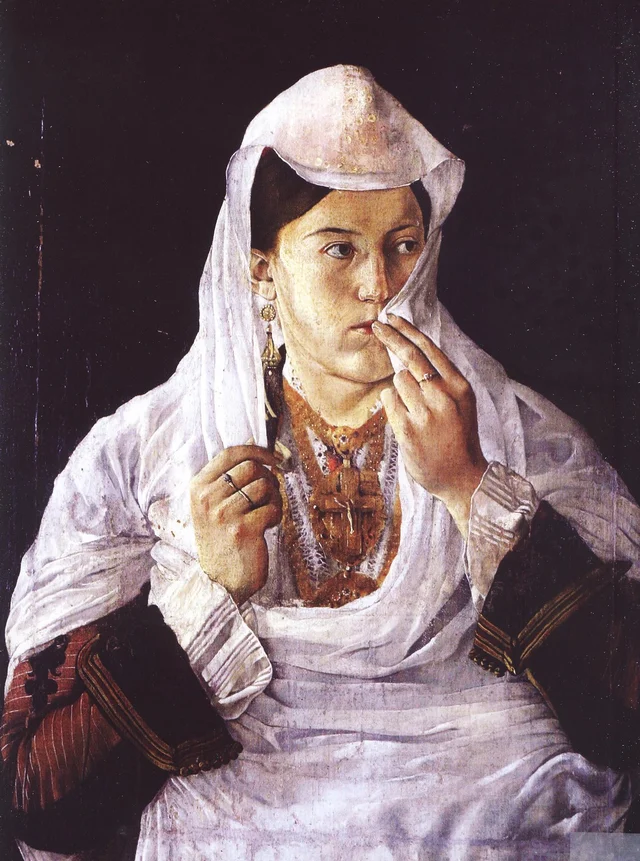
In 1883, in the northern Albanian town of Shkodër, a young man named Kolë Idromeno painted his sister with a gauzy half-veil across her face. That portrait, known as 'Motra Tone', meaning 'My Sister Tone', became one of the best-known paintings in Albanian art, and Idromeno is often called the father of modern Albanian painting.
He was a one-man workshop of the new age. Helped by Pjetër Marubi, from a family of pioneering local photographers, he went to Venice at 15 to study at the fine-arts academy, lasted about six months, learned more as a painter's assistant, and came home in 1878. Back in Shkodër he worked as a painter, sculptor, architect, engineer and photographer, and opened a photo studio with cameras brought from France.
He also brought his country its first moving pictures: in 1912 he signed a contract with an Austrian firm and set up Albania's first rudimentary cinema. Idromeno died in Shkodër in 1939. The half-veiled face of his sister still hangs in the national gallery in Tirana.