Konstantin Somov
1869–1939 · Russian Empire · Modernism
The story
Konstantin Somov built his art out of a century he never lived in. In the years around 1900, while much of Russian painting turned to peasants and social truth, he staged powdered marquises, harlequins and lovers under fireworks, the manners of the 18th century remembered with a faint, knowing irony. He was a founder of the World of Art, the Mir Iskusstva circle around the impresario Sergei Diaghilev, which prized elegance and old European refinement over message.
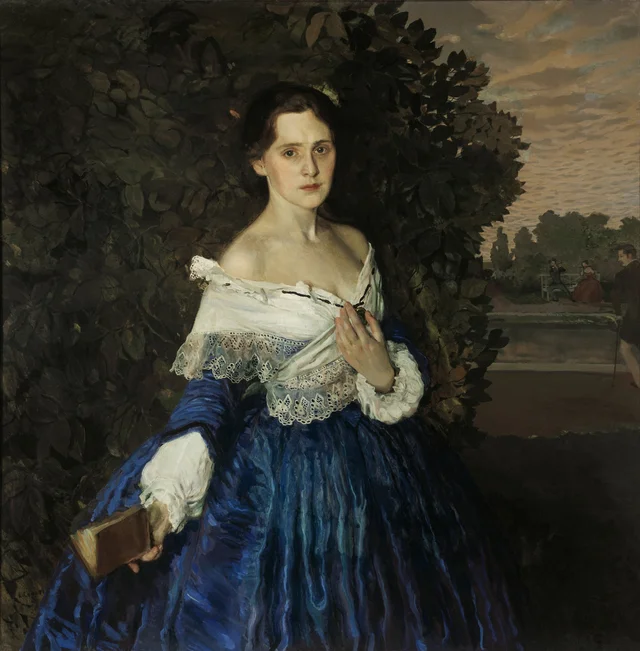
His one great departure from the costume pieces was Lady in Blue, a portrait he worked on from 1897 to 1900. The sitter, the painter Elizaveta Martynova, a friend from his student years, was already ill with the tuberculosis that would kill her young, and Somov set her, in an old-fashioned blue dress, against a parkland that belongs to his imagined past more than to her present.
The revolution of 1917 ended the world he had been quietly mourning. He left Russia in 1923, tried America, found it alien to his art, and settled in Paris, where he kept painting the same fêtes and nudes for private collectors until his death in 1939. Long after, in 2007, his landscape The Rainbow, painted in Paris in 1927, sold at auction for over seven million dollars, briefly the highest price paid for any Russian work.