Kuzma Petrov-Vodkin
1878–1939 · Russian Empire · Russian symbolism
The story
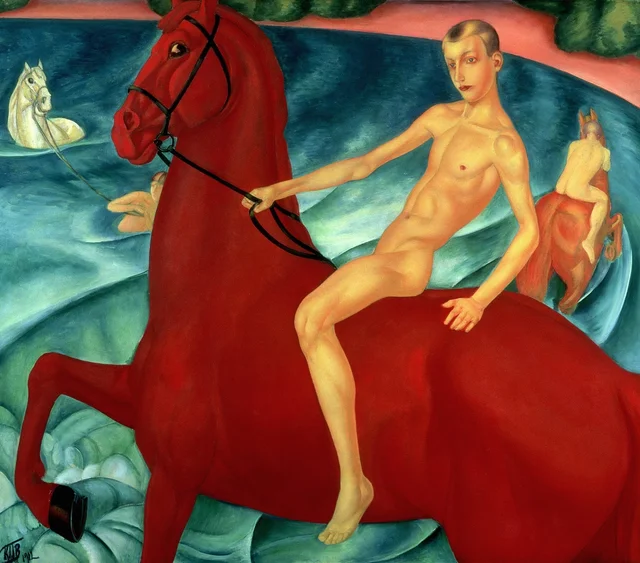
In 1912 Kuzma Petrov-Vodkin showed a picture of a naked boy on a huge red horse wading into water, and Russians read it at once as an omen. The Bathing of the Red Horse, painted two years before the First World War and five before the Revolution, seemed to gallop straight out of an icon into the coming century, and the artist half thought so himself.
He came from a poor family in a Volga town and trained partly abroad, but his real roots were in Russian icon painting, with its flat glowing colour and reversed space. He built a theory from it, a tilted spherical perspective and a palette pared down to red, blue, and yellow ochre, which he applied to Madonna-like peasant mothers and, later, to still lifes seen from above.
He lived on into the Soviet 1930s, teaching and adapting, painting the new order without ever losing that icon-lit strangeness. He died of tuberculosis in 1939.