Le Nain Brothers
Kingdom of France · French Baroque, Baroque, Genre painting
The story
In the corner of a small canvas in the Louvre, the painter wrote "Lenain f. 1642" and nothing more. That bare family name is the puzzle at the heart of the Le Nain brothers. Antoine, Louis and Mathieu came from Laon, a hill town in Picardy in northern France, and by 1630 all three were working in Paris from a single studio set up by Antoine. Their pictures went out under the shared surname, and only about 15 dated works survive, all from the 1640s. Sorting one brother's hand from another's has occupied scholars ever since.
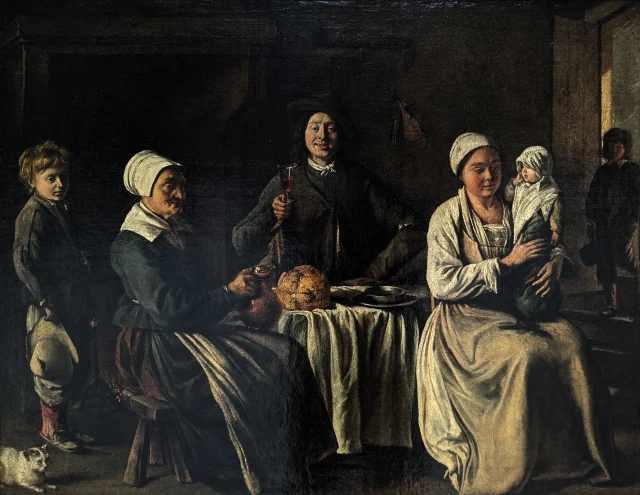
The Happy Family, also called The Return from the Baptism, shows how hard that is. Three generations of a peasant household gather at a table, the father raising a glass while the mother holds a child. Scenes like this, country people shown still and serious, made the brothers' name around 1640. The Louvre's notes lean toward Mathieu as the painter, working under Louis's influence, since some figures recall Louis's compositions. The French art historian Jacques Thuillier cautioned that a single canvas may hold more than one hand. The museum also points out that the child looks too old for a christening of the period, so the old title may mislead.
In 1648 all three were founding members of the new Royal Academy of Painting and Sculpture in Paris. That May, Louis and Antoine died two days apart. Mathieu, the youngest, lived on until 1677. Their reputation later faded, and it was revived by the realist critic Champfleury, himself born in Laon and a friend of the painter Courbet, in studies published in 1850 and 1862.