Leo Putz
1869–1940 · Austria-Hungary, Kingdom of Bavaria · Art Nouveau, Impressionism, Expressionism
The story
In 1909 Leo Putz became a Bavarian citizen. He was born in 1869 in Meran, in the Austrian Tyrol, and had lived in Munich since he was 16, but citizenship was the condition for the title of professor that the Bavarian state gave him that same year.
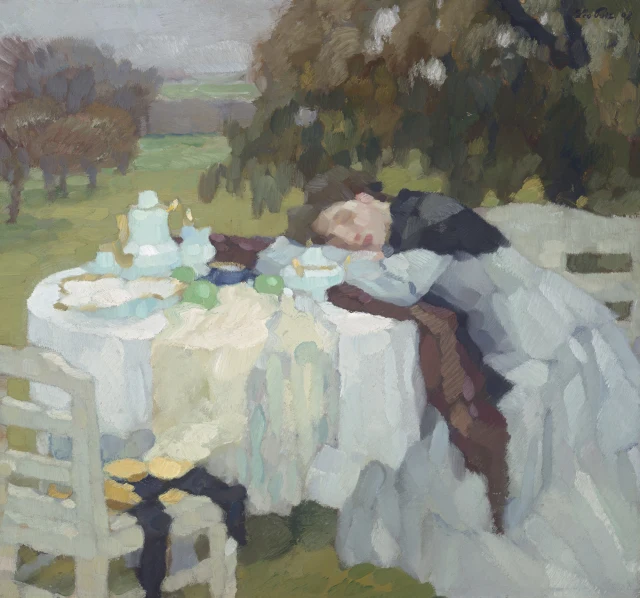
By then he was a familiar name in the city. From 1897 he drew for Jugend, the Munich magazine that gave Jugendstil its name, and in 1899 he was one of the founders of Die Scholle, a group of young Munich painters. In 1905 his Bacchanale was accepted for an exhibition and then taken down for alleged indecency. From 1909 to 1914 he spent his summers at Hartmannsberg Castle near the Chiemsee, painting boats and bathing women out of doors in full sunlight.
At the end of the 1920s he went to South America with his family, and in 1931 he taught at the national school of fine arts in Rio de Janeiro, where the tropical light made his colours stronger and brighter. After his return in 1933 the Nazi press attacked those Brazilian pictures, and in 1937 he was expelled from the Reich Chamber of Culture, without which no artist could work in Germany. He withdrew to Meran, where he painted landscapes and flowers until his death in 1940.