Léon Augustin Lhermitte
1844–1925 · France · Naturalism
The story
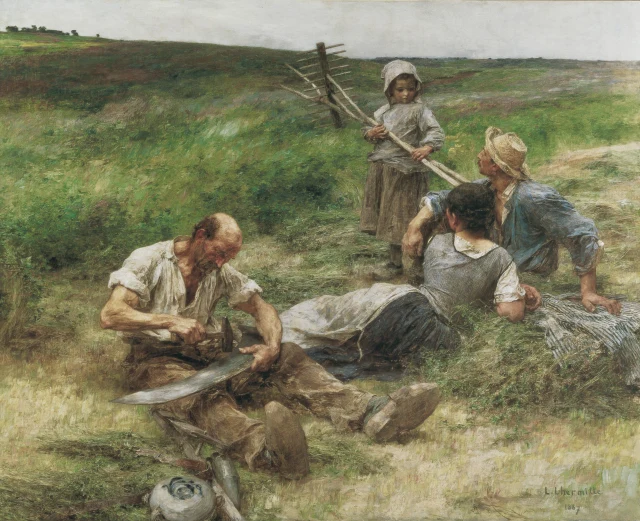
On the opening day of the 1882 Paris Salon the French state bought a wide canvas of farmhands collecting their day's wages at a kitchen table. With that purchase Léon Augustin Lhermitte, then 37, became the Third Republic's painter of country labour. The scene came out of Mont-Saint-Père, the village on the Marne where he was born, the schoolmaster's son, and the people in it were his neighbours. A labourer named Casimir Dehan is recognisable in three of the paintings he made there in those years.
He had reached Paris in 1863, at the free state drawing school known as the Petite École, where Horace Lecoq de Boisbaudran trained his pupils, Rodin and the painter Fantin-Latour among them, to memorise a scene and draw it afterwards with no model in front of them. Charcoal and pastel stayed as natural to Lhermitte as oil for the rest of his life.
Van Gogh knew much of that work through the illustrated press. In Nuenen in 1885 he was cutting Lhermitte's compositions out of the Paris weekly Le Monde illustré and writing to his friend, the Dutch painter Anthon van Rappard, that here was a second Millet, in the full sense of the term. Jean-François Millet, the great painter of French peasants, had died ten years earlier, and for Van Gogh there was no higher name. To Theo he spelled out what he admired: Lhermitte builds a figure out of the light first, the way Rembrandt did.
He kept to rural subjects to the end of the century. A crowded morning at the Les Halles food markets in Paris went to the Salon of 1895, hung first in the Paris city hall and moved to the Petit Palais in 1904. In 1905 he took the Académie des Beaux-Arts seat left by the painter Jean-Jacques Henner.