Leonhard Beck
1542 · Holy Roman Empire · German Renaissance
The story
In 1517 the Nuremberg printer Johann Schönsperger issued Theuerdank, a verse romance about a knight who rides through one danger after another to reach his bride. Everyone at court knew the knight was Emperor Maximilian I and the bride Mary of Burgundy, his first wife. Of the book's 118 woodcuts, 77 were designed by Leonhard Beck, a painter from Augsburg, and when the emperor demanded changes for the second edition of 1519, Beck reworked many of the other designers' blocks as well.
He came from a family of book painters. His father, Georg Beck, illuminated psalters for an Augsburg monastery, and the son worked beside him before joining Hans Holbein the Elder, the city's leading painter, on an altarpiece for the Dominicans of Frankfurt around 1500. In 1503 he became a master in Augsburg, and he stayed there until his death in 1542.
Maximilian meant printed pictures to spread his fame, and Beck drew for him steadily. He designed 126 blocks for the Weisskunig, the emperor's thinly disguised autobiography, and well over a hundred saints whom the court historian Jakob Mennel counted as Habsburg relatives. That book of saints was never finished in the emperor's lifetime. The full set was first published in 1799, and 121 of the carved blocks survive in the Albertina, the print collection in Vienna.
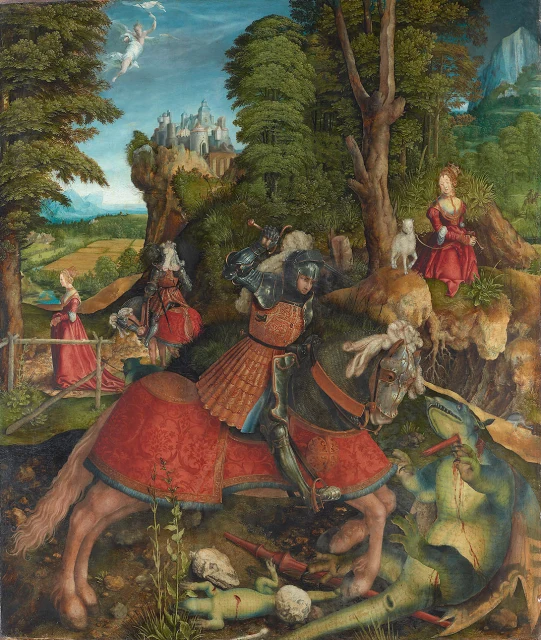
Very few paintings can be tied to him with confidence. The best known is a Saint George fighting the dragon, painted around 1513 and now in the Kunsthistorisches Museum in Vienna.