Lluís Dalmau
Crown of Aragon · Hispano-Flemish, Gothic, Northern Renaissance
The story
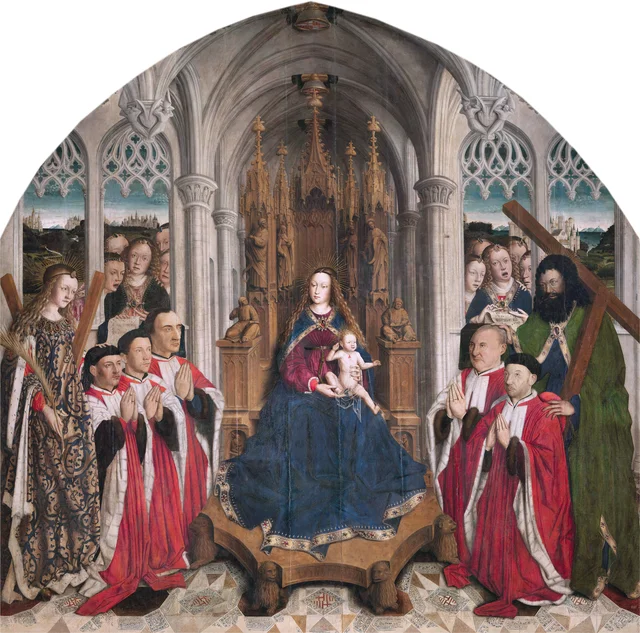
On 29 October 1443 the five councillors who governed Barcelona signed a contract with the painter Lluís Dalmau for the chapel of their city hall. They asked to be shown kneeling at the Virgin's feet in their ceremonial robes, each with his own face. Dalmau signed and dated the panel in 1445. The Virgin of the Councillors is now in the Museu Nacional d'Art de Catalunya, in Barcelona.
The panel brought the new Flemish manner straight into Catalan painting. Dalmau worked in oil, painted true likenesses, and replaced the customary gold background with a landscape. His throne and his groups of singing angels come close to Jan van Eyck, the Flemish master of the Ghent Altarpiece. That closeness has a documented background. Dalmau, a Valencian, was painter to King Alfonso the Magnanimous of Aragon, and in 1431 the king sent him to Flanders, where Van Eyck was then working.
His birth date is unrecorded. He is documented from 1428 and last appears in Barcelona after 1460, and only two works are securely documented as his. The councillors named in the contract, Joan Llull and Ramon Savall among them, still kneel at the foot of the throne beside Saint Eulalia, patron of Barcelona, and Saint Andrew.