Lorenzo Vallés
1831–1910 · Spain · Academic art, Realism
The story
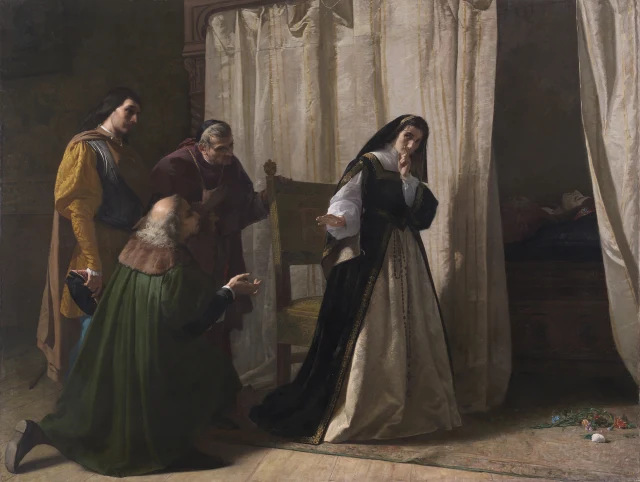
Joanna of Castile, the daughter of Ferdinand and Isabella, is shown in a dim room beside the coffin of her husband Philip of Habsburg, dead at 28, with the candles doing most of the lighting. Lorenzo Vallés signed the canvas on the base of the catafalque, in gothic lettering: "L. Vallés Roma 1866". He was living in Rome, one of a Spanish colony of painters there who shipped large history pictures home for the National Exhibitions in Madrid. This one took a second medal, and the sources disagree about the year, some giving the exhibition of 1866, others 1867. It travelled on to the world's fairs in Vienna in 1873 and Philadelphia in 1876.
Francisco Pradilla painted the same queen 11 years later, out on a windswept plain with the funeral cortège, and that is the version that became famous. Both pictures are in the Prado, two painters on one subject.
Vallés was born in Madrid, in 1831 by most accounts, though the Prado's own author card gives 1830. He trained at the San Fernando academy under Francisco Cerdá de Villarestán and went to Rome around 1853 on a pension from the Duke of Sesto, an aristocratic patron. In Rome he entered the workshop of Johann Friedrich Overbeck, the German painter of a religious revivalist school, and what he went on to produce was academic history painting for the Spanish exhibition circuit. Accounts of his later years disagree, some have him back in Spain painting genre scenes and portraits. He died in Rome in 1910.