Louis Finson
1617 · Southern Netherlands · Caravaggism, Baroque, Northern Caravaggesque
The story
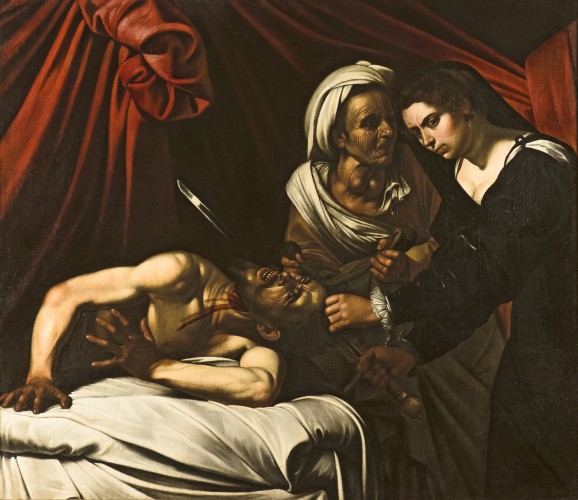
When the painter Caravaggio left Naples in June 1607, still on the run from a murder charge in Rome, he left two of his canvases in a studio shared by two Flemish painters, Louis Finson and his business partner Abraham Vinck. One was the Madonna of the Rosary, a large altarpiece. The other was a Judith beheading Holofernes. Finson knew Caravaggio personally in Naples and became one of the first Northern artists to work in his manner, with hard light falling out of darkness onto faces and hands.
The Judith in our catalogue, dated 1607 and now in the Gallerie d'Italia on Via Toledo in Naples, is Finson's version of that composition. Caravaggio's own Judith from those years is lost, so copies like this one are how scholars picture it. In 2014 another Judith turned up in an attic in Toulouse, and experts still disagree over whether it is Caravaggio's lost original or an earlier version by Finson. It was sold privately in 2019, shortly before a planned auction.
Finson himself never stayed long anywhere. Born in Bruges sometime between 1574 and 1580, he moved on from Naples to Rome and then to Marseille in 1613, painting altarpieces for churches in Aix-en-Provence, Arles and Montpellier before reaching Paris. By 1616 he was in Amsterdam, where Vinck had settled with the two Caravaggios. In September 1617 Finson made his will and left his share in both pictures to Vinck, and on 1 October he was buried in the Oude Kerk, the city's oldest church.