Luc-Olivier Merson
1846–1920 · France · Academic art
The story
By 1900, more French people had seen Luc-Olivier Merson's work than had ever walked into a Salon. The national post hired him to design its postage stamps, and within a few years the Bank of France put his allegorical figures on its banknotes. For decades his drawing passed through millions of hands as everyday change, while the painter himself belonged to the grand academic tradition that was falling out of fashion.
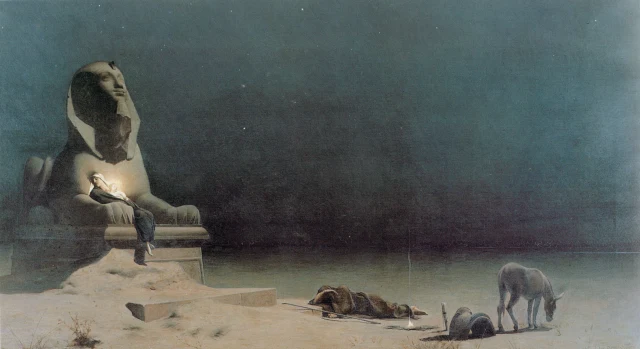
Merson had won the Prix de Rome, the state's top art prize, in 1869, and built his name on carefully finished historical and religious scenes. The one still reproduced today is his 'Rest on the Flight into Egypt' from 1879. Instead of the usual roadside halt, he laid the sleeping Virgin and Child against the paws of a giant Sphinx in the empty desert, a small fire glowing at its base. That odd pairing, a Christian family sheltered by an Egyptian idol, is what fixed the image in memory.
He also worked in mosaic and book illustration and decorated public buildings around Paris. Toward the end of his life the polished Salon manner he had mastered was being pushed aside by the modern painting he disliked. He died in Paris in 1920, at 74, still under contract to design the country's paper money.