Luigi Pampaloni
1791–1847 · Grand Duchy of Tuscany · Neoclassicism
The story
In 1838 Luigi Pampaloni finished a monument in the Florentine church of Santa Croce to Virginia de Blasis, a soprano who had died young. He carved her kneeling with her hands raised, and cut beneath her feet the words of an aria from Bellini's opera Beatrice di Tenda. Critics praised it as Christian sculpture, the woman and her prayer with none of the usual weeping spirits, muses or pagan gods.
Pampaloni was born in Florence in 1791, the son of a small merchant. He learned to carve alabaster with his brother in Pisa, then followed the classes of Lorenzo Bartolini, the leading Florentine sculptor of the day, at the academy in Carrara, and for years worked in Bartolini's studio turning out small pieces for sale. His own name was made in 1826 by a child kneeling in prayer on a cushion, first made for a Polish nobleman's tomb. Copies of it travelled far beyond Tuscany.
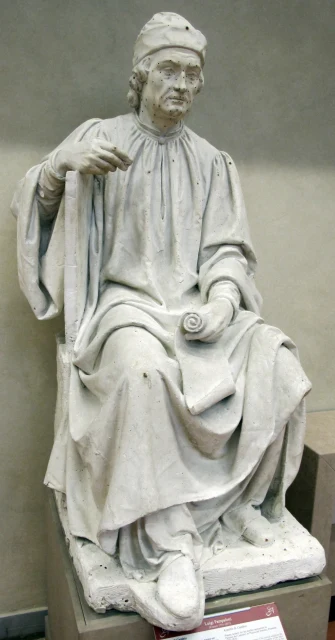
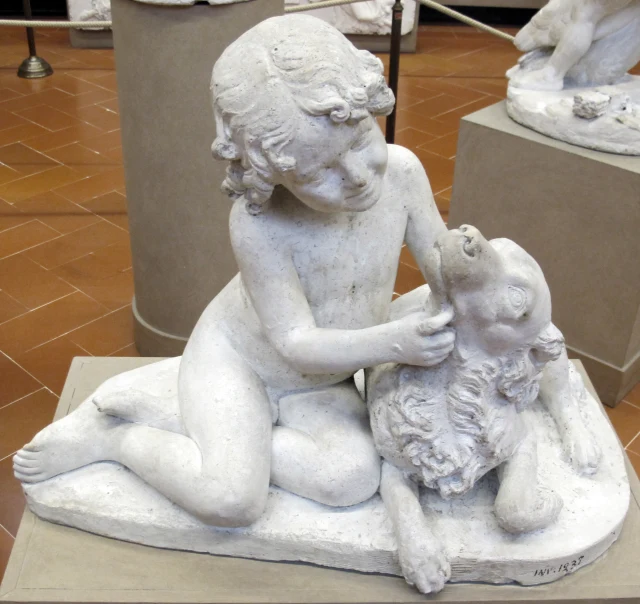
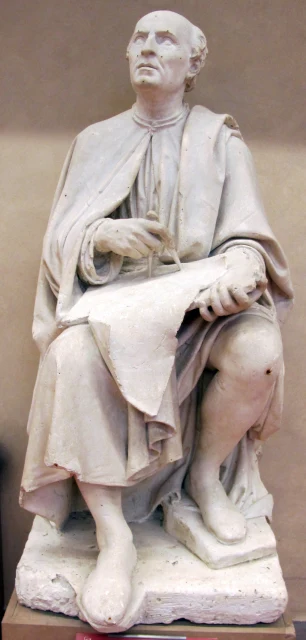
He worked in two registers. For the Grand Duke and the city he made grave public figures, among them the seated architects Arnolfo di Cambio and Filippo Brunelleschi on Piazza del Duomo, set in place in 1830, and a Leonardo da Vinci for the Uffizi portico in 1842. For collectors he made gentle children and animals, which earned him the nickname "the Anacreon of sculpture", after the Greek poet of light verse. Polish aristocrats and the Bonaparte family ordered tombs from him, down to a memorial for Julie Clary, the wife of Joseph Bonaparte, finished in 1847, the year he died.
In 1890 his daughter Giuseppa gave the plaster models left in his studio to the Florentine museums. After the flood of 1966 they were moved to the Galleria dell'Accademia, where they now stand in the same hall as the plasters of his teacher.