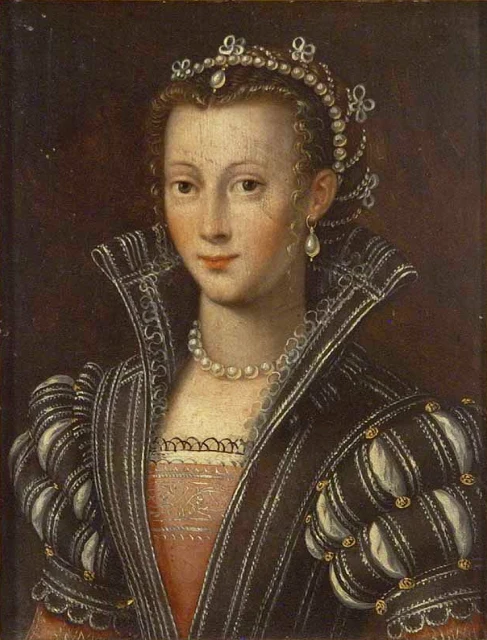
Manner of Alessandro Allori
Duchy of Florence · Mannerism
The story
The Medici wanted their ancestors on the wall, including the ones nobody had ever painted from life. Contessina de' Medici, a daughter of Lorenzo the Magnificent, died in 1515, and no likeness made in her lifetime is known. The portraits of her that exist were invented decades later by Florentine painters working in the manner of the grand ducal court, and a small panel at Palazzo Pitti carries this label.
Maniera di is the faintest of the formulas the Italian catalogue uses for authorship. Bottega di puts the work inside the master's own rooms. Scuola di means a painter trained in his following. Maniera di makes no claim about a workshop at all. It says that the picture speaks his stylistic language, that the hand is unidentified, and that whoever held the brush may never have met him and may have worked a generation later.
That language here is Alessandro Allori's. His father died when he was a child, and Bronzino, the portraitist of the Florentine court, brought him up and trained him. Allori took over that cool enamelled manner and ran the busiest workshop in the city until his death in 1607. In 1584 Grand Duke Francesco de' Medici ordered the serie aulica, a corridor of family portraits reaching back through generations no living painter had seen, and Allori was one of the hands on it. This Contessina belongs to a group of related versions, among them a three-quarter length in Mantua with a lapdog. On the back of the panel the old inventory number 556 is still there, brushed in red lead.