Marie-Denise Villers
1774–1821 · France · Neoclassicism
The story
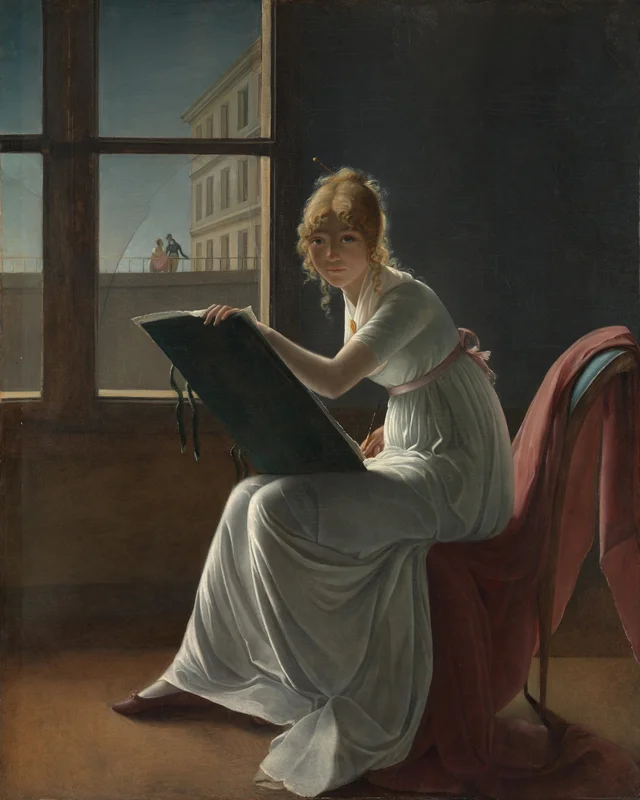
When the Metropolitan Museum bought this luminous portrait of a young woman at her drawing board in 1917, it hung under a great name: Jacques-Louis David, the ruling painter of the French Revolution. For decades it was prized as the New York David, admired for its cool light and its calm, self-possessed sitter.
Then the name came apart. Doubts grew through the 1950s, and in 1996 the art historian Margaret Oppenheimer argued that the picture was really the work of Marie-Denise Villers, a Parisian painter trained in David's orbit who had shown it at the Salon of 1801. Villers came from a family of painters, and she worked at a moment when only a handful of women could push into the male world of the Paris exhibitions.
The change had a strange afterlife. In 1971 the painting had appeared on the cover of ARTnews beside Linda Nochlin's essay Why Have There Been No Great Women Artists — an image most readers assumed was by a man. Look past the sitter to the window behind her, and you can still find the cracked pane and the small distant couple that early admirers once read as the signature touch of a master.