Marius Bauer
1867–1932 · Kingdom of the Netherlands · Orientalism
The story
In 1888 an Amsterdam art dealer paid for a 21-year-old painter to go and look at Constantinople, and Marius Bauer came back knowing what he would draw for the rest of his life. The firm was Van Wisselingh, and the trip turned a restless dropout from the Hague academy into one of the best-known Dutch artists of the East.
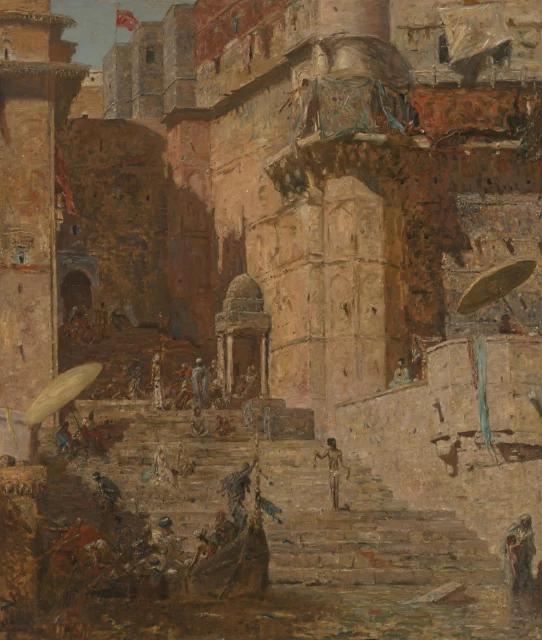
Bauer worked above all with the etching needle. His prints of crowded bazaars, processions and mosque courtyards, bitten into copper with deep shadows that reminded people of Rembrandt, won him a Grand Prix at the Paris World's Fair of 1900. He travelled again and again, to Egypt and Palestine, Morocco and Algeria, Ceylon and the Dutch East Indies, and twice to India, first in 1897 and 1898 and again in 1924 and 1925. Much of what he later painted was worked up at home from sketches and from photographs he had bought on the road.
In 1902 he married Jo Stumpff, herself a painter and one of the Amsterdam women artists known as the Joffers. He died in Amsterdam in July 1932, at 65, and a street in the city's Overtoomse Veld district carries his name.