Marquard Wocher
1760–1830 · Germany, Switzerland · Romanticism, Panoramic art
The story
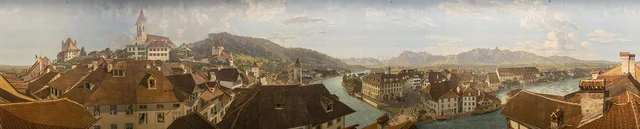
In 1814, visitors in Basel could step into a round building and find themselves on a rooftop in Thun, a small Swiss town on the River Aare, with the old streets, the castle, the lake and the mountains beyond on every side. The painter of that illusion was Marquard Wocher. His picture, about 38 metres long and more than seven metres high, is usually described as the oldest panorama to survive anywhere, in a form that had been patented in Britain only in 1787.
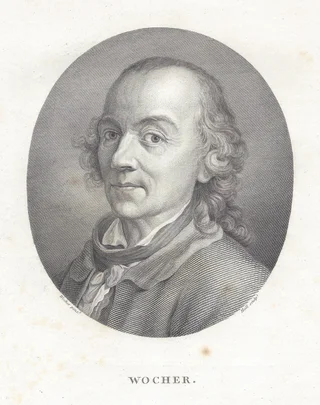
Wocher was born in 1760 in Mimmenhausen, near Lake Constance, the son of the painter Tiberius Wocher. He spent time in the workshop of Johann Ludwig Aberli, a Bern painter of Swiss views, settled in Basel in 1782 and made his living from portraits and miniatures. Around 1804 he began sketching Thun from a rooftop, and from 1809 he spent five years painting the scene on paper mounted on canvas, filling the streets with some 300 people going about an early morning in the town.
The panorama drew visitors from across Europe, among them the Empress Marie Louise, Napoleon's wife. It was expensive to keep up, and Wocher never managed to sell it. After his death in Basel in 1830 it was given to Thun, and since 1961 it has hung in a purpose-built rotunda in the town's Schadau Park.