Martinus Josephus Geeraerts
1707–1791 · Austrian Netherlands · Rococo
The story
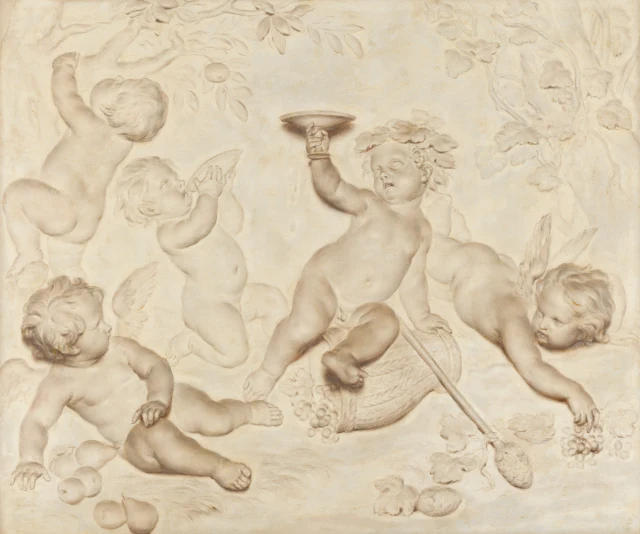
In the transept of Cambrai Cathedral, in northern France, you see what look like nine large stone reliefs, scenes of the Passion of Christ on one side and of the life of the Virgin on the other, several after compositions by Rubens. They are flat canvases, painted in greys by Martinus Josephus Geeraerts between 1756 and 1760 for what was then the abbey church of Saint-Sépulcre. The church became the cathedral in 1804, after the old cathedral had been destroyed in the Revolution.
Geeraerts was baptised in Antwerp Cathedral in 1707, the son of a jeweller. His family intended him for the law and sent him to the Jesuit college, but he chose painting, trained with the Antwerp painter Abraham Godijn and became a master in the painters' guild in 1731. He began in colour. From the 1740s he painted almost nothing but grisailles, pictures in shades of grey imitating marble reliefs, together with illusions of carved wood and bronze.
The work found buyers in the Dutch Republic, Austria, Russia, Poland, England and Italy, and in 1759 Charles of Lorraine, governor of the Austrian Netherlands, called at his studio. From 1741 he was one of the six unpaid directors of the Antwerp Academy. He never married, and in old age he lived with two nieces who were his wards. When he died in 1791 he was buried in the cathedral where he had been baptised.