Master of Dreux Budé
Kingdom of France · Early Netherlandish painting
The story
This painter has no name of his own. Art historians call him the Master of Dreux Budé, after the man who ordered his best-known altarpiece around 1450. Dreux Budé was a notary and secretary to King Charles VII of France. The triptych he paid for was later split up. Its central Crucifixion is now in the Getty Museum in Los Angeles, and a wing with the Resurrection, where Saint Catherine presents his wife Jeanne Peschard and their daughters, is in the Musée Fabre in Montpellier.
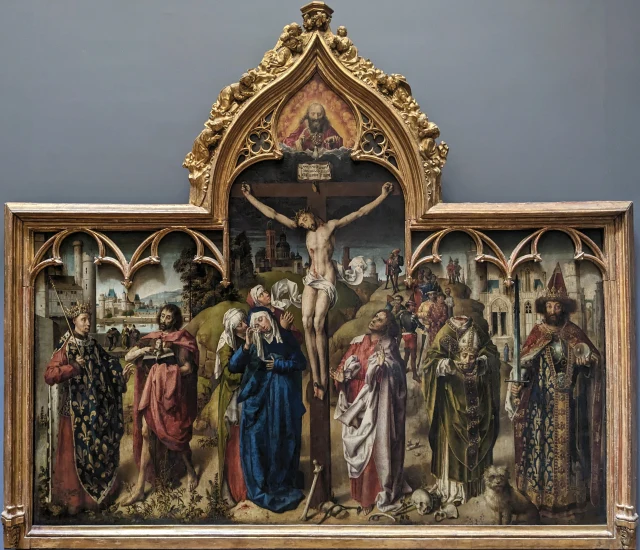
The same painter is credited with the large Crucifixion made about 1452 for the Grand Chamber of the Parlement of Paris, the kingdom's high court. Saint Louis and Saint John the Baptist stand on one side of the cross, Saint Denis and Charlemagne on the other, and behind them runs Paris itself, with the Tour de Nesle, the Seine, the Louvre and the court's own palace on the Île de la Cité. Seized in the Revolution, the panel hung in the Paris appeal court from 1808 and reached the Louvre in 1904.
Many scholars think the master was André d'Ypres, a painter recorded in Amiens in the 1420s, admitted as a master in the painters' guild of Tournai in 1428 and settled in Paris by about 1445. He died at Mons in July 1450 on his way back from a pilgrimage to Rome, and his son Colin d'Amiens may have finished the Parlement picture. The identification is plausible but unproven, and the Louvre prints André's name with a question mark.