Master of Frankfurt
Burgundian Netherlands · Northern Renaissance, Flemish Renaissance
The story
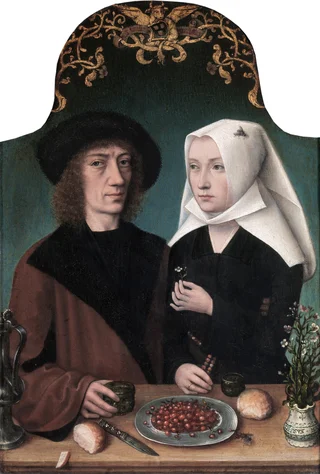
In 1496 an Antwerp painter put himself and his wife side by side on one panel and wrote down their ages, 36 and 27. Above them hangs the coat of arms of the Guild of St Luke, the city's painters' guild, and a painted fly has landed on the woman's white headdress. We still do not know his name. That double portrait, now in the Royal Museum of Fine Arts in Antwerp, is the only reason his birth is placed around 1460.
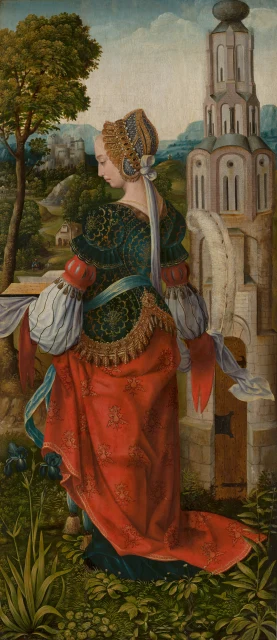
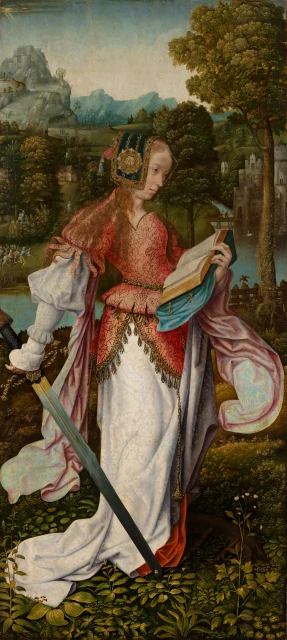
Scholars call him the Master of Frankfurt because two of his largest altarpieces were made for that German city. One, a Holy Kinship showing the wider family of Saint Anne, stood in Frankfurt's Dominican church and is now in the city's Historical Museum. The other, a Crucifixion triptych painted for the Humbracht family of Frankfurt patricians, is in the Städel. In the 19th century this led people to take him for a local German master, although his style and his guild both point to Antwerp, where he worked from about 1480 to 1520.
Some historians have tried to identify him with Hendrik van Wueluwe, a well-known Antwerp painter who served several times as dean of the guild and died in 1533, but no document links the two.