Master of Saint Giles
France · Late Gothic, Franco-Flemish painting, Northern Renaissance
The story
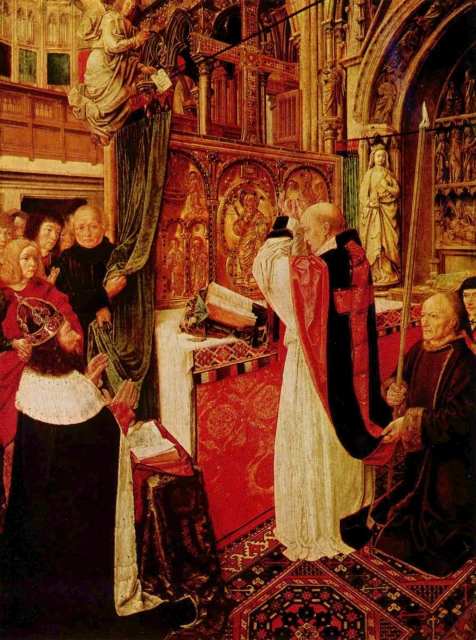
In a painting at the National Gallery in London, the hermit Saint Giles raises the host at the high altar of Saint-Denis, the abbey north of Paris where the kings of France were buried. The altar is painted with the care of a record. Its gold altarpiece and the tall jewelled cross above it were real treasures of the abbey, destroyed during the French Revolution, and this picture shows how they looked. Kneeling in front is the emperor Charlemagne. By legend he had a sin too terrible to confess, and as Giles says Mass, an angel brings down a written pardon.
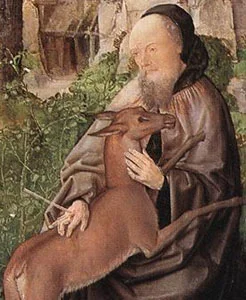
The painter's name is lost. He is called the Master of Saint Giles after this panel and its companion, Saint Giles and the Deer, also in London, where the hermit shields a hind from a royal hunt. Two more panels, now in the National Gallery of Art in Washington, seem to come from the same altarpiece of around 1500, and one of them sets the baptism of Clovis, the first Christian king of the Franks, inside a church modelled on the Sainte-Chapelle in Paris.
Whether he was a Frenchman trained in the Low Countries or a Netherlander who settled in Paris is still unresolved. His view of Saint-Denis is exact down to the tomb of King Dagobert, a seventh-century Frankish ruler, standing at the right of the choir.