Master of Schloss Lichtenstein
Holy Roman Empire · Late Gothic
The story
The name comes from a romantic castle. Schloss Lichtenstein, on a cliff in Württemberg in southwest Germany, was rebuilt in the 1840s as a neo-Gothic fantasy for Count Wilhelm of Württemberg, and his family, later the dukes of Urach, has kept two large panels there since the 19th century, a Death and a Coronation of the Virgin. Art historians named the unknown painter after them.
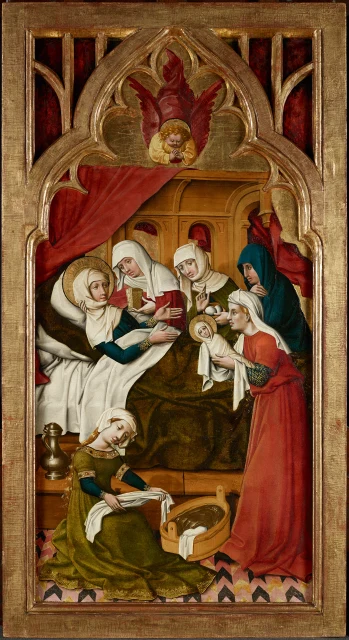
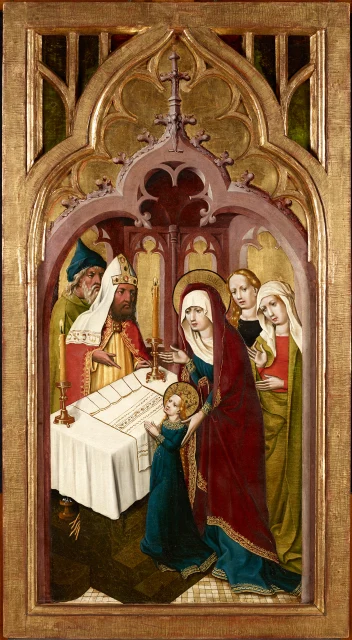
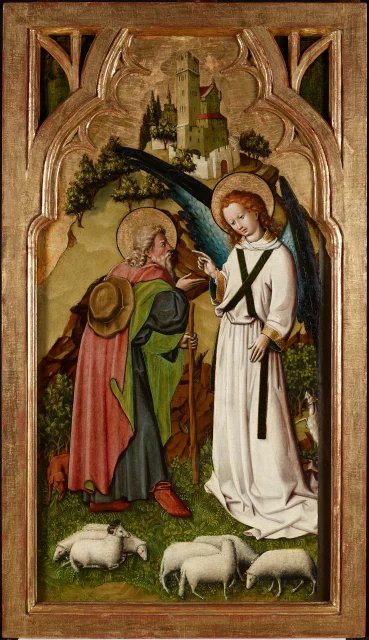
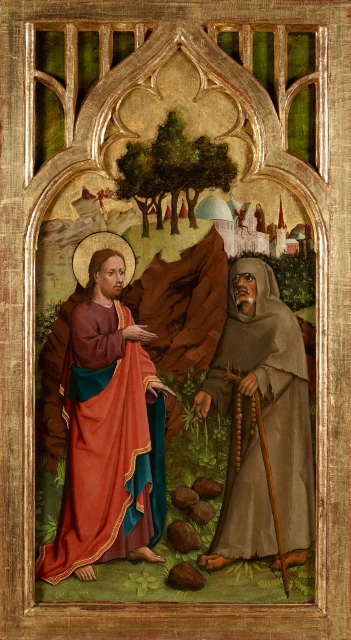
He actually worked in Vienna, in the 1440s. Research has shown that 23 surviving panels once belonged to one double-winged altarpiece almost six metres wide, with scenes from the life of Mary, the childhood of Christ and the Passion, probably made in Vienna for a church in southern Germany. The pieces are now spread from Basel and Munich to Philadelphia, Warsaw, Tallinn and Moscow. The Belvedere holds the largest group, including the Birth of the Virgin, the Presentation of Mary in the Temple, the Angel's Message to Joachim and the Temptation of Christ.
His solid figures and deep landscapes show what Viennese painters were learning from Flemish masters such as Jan van Eyck and Rogier van der Weyden. Some scholars link him to the workshop of Jakob Kaschauer, a documented Viennese painter and sculptor, though the evidence is thin. In 2013 the Belvedere brought 20 of the panels together in its exhibition Vienna 1450.