Master of the Aachen Altar
Holy Roman Empire · Late Gothic, Northern Renaissance, Cologne school
The story
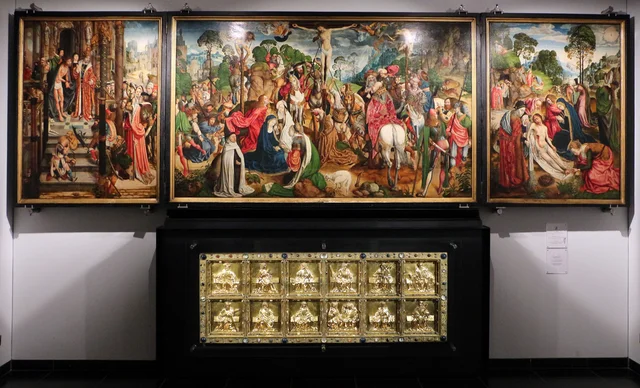
In the church of the Carmelite friars in Cologne, a large Passion triptych served for more than a century as the people's altar, the one where ordinary worshippers gathered. It was painted around 1515 to 1520, and after passing through Cologne collections it was bought by Aachen Cathedral in 1872. That purchase gave its painter a name. The Master of the Aachen Altar is a label invented by scholars, because no document links these pictures to any painter recorded in Cologne's archives.
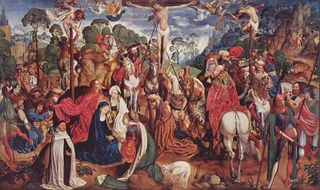
The altarpiece reads like a crowded street play. Across its three panels Christ is crowned with thorns, led to Calvary, crucified, descends into hell, is mourned and buried, and finally ascends, while Judas hangs himself at the edge of the central scene. The onlookers wear the clothes of Cologne around 1500, and some soldiers carry armour in the Turkish style, at a time when the Ottoman advance worried much of Europe.
An earlier work by the same hand is now split between two cities. Its central Crucifixion hangs in the National Gallery in London, and its wings are in the Walker Art Gallery in Liverpool. When the altarpiece was cleaned in 1963, overpaint came off the backs of the wings and revealed its donors, Hermann Rinck, three times mayor of Cologne in the 1480s, and his wife with three of their sons.