Master of the Amsterdam Death of the Virgin
Northern Netherlands, Habsburg Netherlands · Early Netherlandish painting
The story
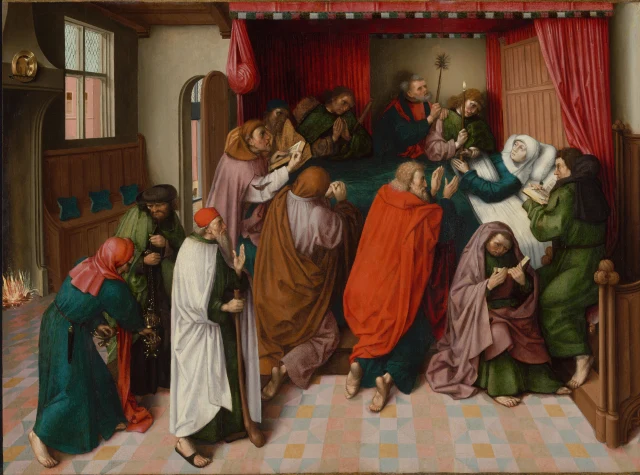
This painter has no name of his own. In 1932 the German scholar Max Friedländer, a leading expert on early Netherlandish art, named him after a Death of the Virgin that then belonged to the Almshouse of the Seven Electors, a charitable home in Amsterdam. The panel, which the Rijksmuseum acquired in 1944, shows Mary dying among the twelve apostles in a crowded room, painted with the expressive heads and warm, many-coloured palette that mark this hand.
Friedländer saw him as an Amsterdam painter working around 1500, a forerunner of Jacob Cornelisz van Oostsanen, the city's leading painter a generation later. The Dutch scholar Hoogewerff proposed Utrecht instead, and others have looked to the eastern Netherlands, around Arnhem and Nijmegen. No one has linked him to a documented name. A double portrait of a Utrecht couple in Rotterdam's Museum Boijmans Van Beuningen is also given to him, while two Passion scenes in the Rijksmuseum remain disputed. Tree-ring dating of the Death of the Virgin puts it no earlier than 1491 and more likely after 1505, surprisingly late for its old-fashioned style.