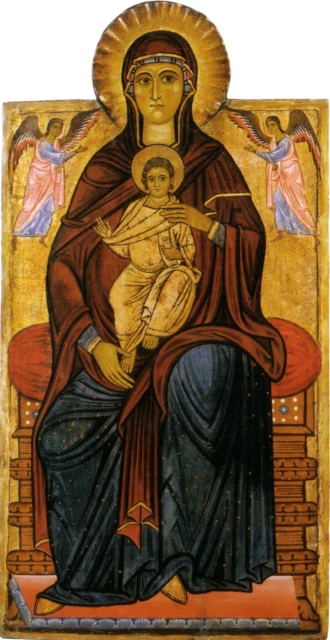
Master of the Bigallo Crucifixion
Italian · Italo-Byzantine
The story
A generation before Cimabue, and two before Giotto, Florentine churches were hung with tall painted crosses in the Greek manner, flat and gold-grounded, the figures drawn more than modelled. One of the painters turning them out ran what may be the earliest organised workshop in the city, and we know him only as the Master of the Bigallo Crucifix, after the great cross still kept in the Museo del Bigallo beside Florence's cathedral square.
He was active from about 1220 into the 1260s, when Italian painters learned their trade from Byzantine models, the stiff poses and strong dark outlines that came west on the pages of illuminated manuscripts. On his crosses Christ hangs alive and upright, eyes open, the older type that Cimabue's generation would soon replace with a slumped, suffering body.
His earliest securely given work is a small panel with four scenes from the life of Saint Zenobius, an early bishop of Florence, now in the cathedral museum.