Master of the Housebook
Holy Roman Empire · German Renaissance
The story
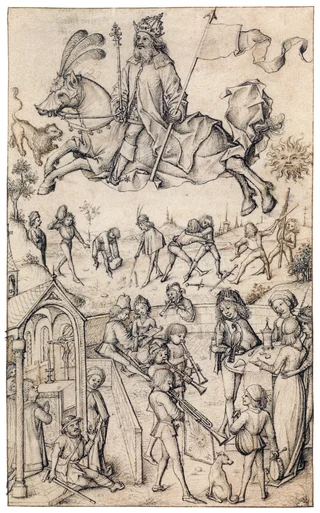
At Wolfegg Castle in southern Germany, the counts and later princes of Waldburg-Wolfegg have kept since the 17th century a manuscript known as the Housebook. Its pages, made around 1480, mix practical knowledge with pictures. There are drawings of mining and smelting, war machines and army camps, a tournament, and the children of the planets, people shown going about their lives under the star that rules them, lovers, bathers, hunters and criminals among them. The finest of these drawings gave a name to an anonymous artist, the Master of the Housebook, who worked in the Middle Rhine region around Mainz, roughly between 1470 and 1500.
He is just as well known for his prints, and here the trail leads to Amsterdam. Of the 91 prints known by him, 82 are in the print room of the Rijksmuseum, which is why older books call him the Master of the Amsterdam Cabinet. He scratched his designs straight into soft metal plates with a needle, the technique called drypoint, so each plate yielded only a few good impressions with soft, velvety lines. Many of his prints survive in a single impression.
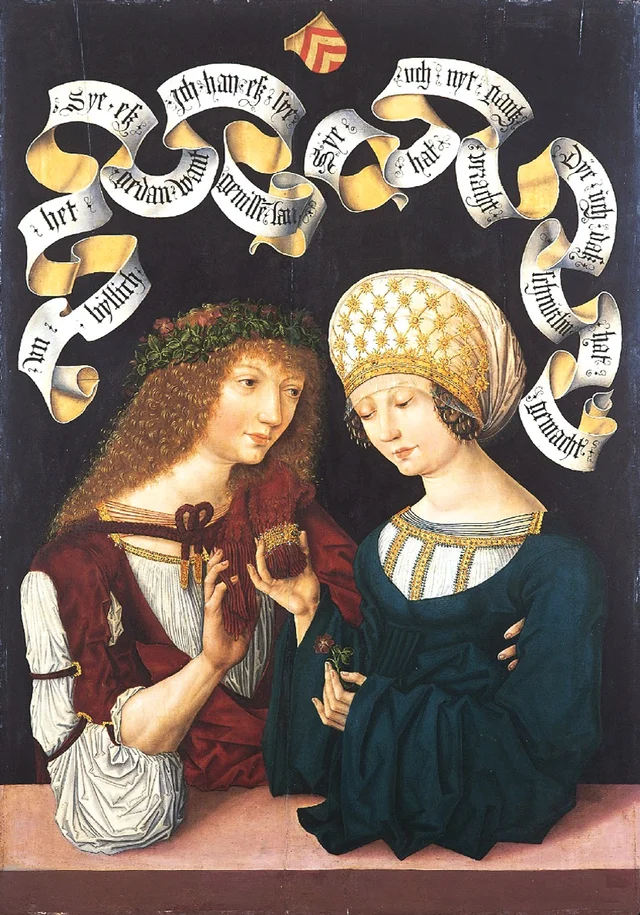
He also painted. The Gotha Lovers, from about 1480 to 1485, is one of the earliest large double portraits in German art and is attributed to him. It shows Count Philipp of Hanau-Münzenberg with Margarete Weißkirchner, a commoner he could not marry, who lived at his side as his partner for more than 20 years.