Master of the Kaufmann Crucifixion
Holy Roman Empire · Northern Renaissance, Gothic
The story
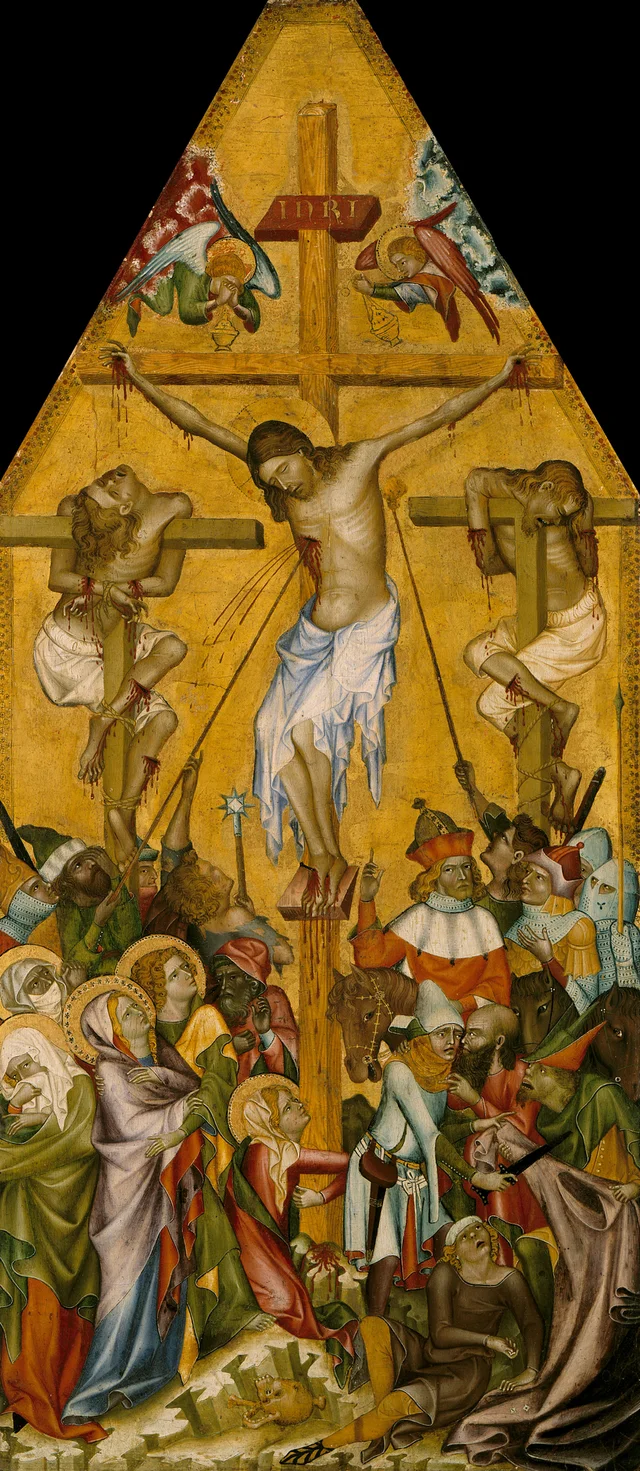
In 1344 Prague was raised to an archbishopric, and two years later the future emperor Charles IV became king of Bohemia. Painters in the city were looking hard at Italy in those years, and a small panel from that moment gave an unknown artist his name. It is called the Kaufmann Crucifixion after a former owner, the Berlin collector Richard von Kaufmann, and it now hangs in the Gemäldegalerie in Berlin.
The panel is only 67 centimetres tall and was probably the centre of a small folding altarpiece. Into that narrow space the painter fitted a crowded Calvary with three crosses, the mourners and soldiers beneath them, and figures foreshortened in depth in the Italian way. It is the earliest known Calvary of this kind in Bohemian painting, and scholars also see Austrian and French models in its sharp drawing and bright colour.
Where the master worked is still debated. Some link him to Bohemia and the circle of the Master of Vyšší Brod, painter of an altarpiece cycle for a Cistercian abbey in southern Bohemia. Others place him in an Austrian workshop connected with Klosterneuburg Abbey near Vienna, and proposed dates for the panel run from about 1340 to after 1350.