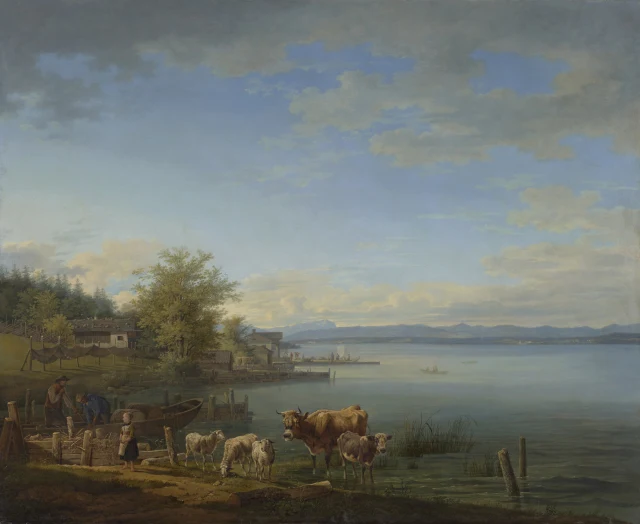
Max Joseph Wagenbauer
1775–1829 · Kingdom of Bavaria · Neoclassicism, Biedermeier
The story
At the end of the 1790s a young Bavarian draughtsman ran out of money for his studies and signed on as a volunteer in a cavalry regiment. Max Joseph Wagenbauer served from 1797 to 1801, and when he came back the state began paying him a yearly sum for his careful drawings. By 1802 he was court and cabinet draughtsman.
His real school was walking. Summer after summer he crossed Bavaria with his watercolours, from Lake Constance to the Upper Palatinate and the Wetterstein mountains, and that patient work on the spot pulled his landscapes away from the stock formulas of the day. He was also a busy lithographer, and his drawing models were used in schools across southern Germany.
In 1815 the king made him inspector of the royal picture gallery. After 1820 he turned more and more to oil and to animals, studying the 17th-century Dutch painters Paulus Potter and Adriaen van de Velde, both masters of cattle in open country. He helped found the Munich Kunstverein, the city's art association, in 1823, and died of typhus in Munich in 1829.