Max Oppenheimer
1885–1954 · Austria, United States · Expressionism
The story
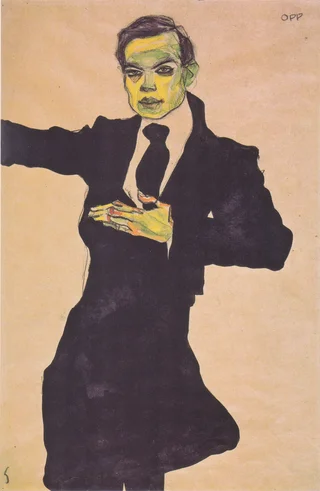
In the winter of 1910 Max Oppenheimer was working in Egon Schiele's studio in Vienna, and the two young painters portrayed each other several times. He signed himself MOPP, had trained at the academies of Vienna and Prague, and had shown in the Kunstschau exhibitions of 1908 and 1909 organised by Gustav Klimt's circle. With Oskar Kokoschka, the other rising Expressionist, things went badly. Oppenheimer's poster for his first Munich show was a gaunt, bleeding self-portrait, and Kokoschka accused him of copying a poster of his own.
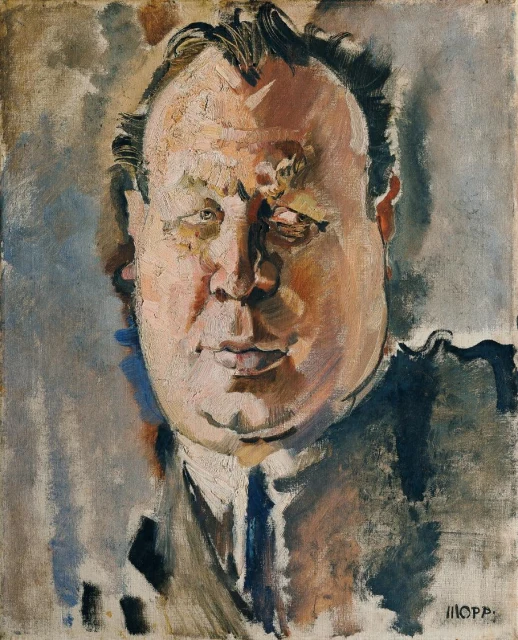
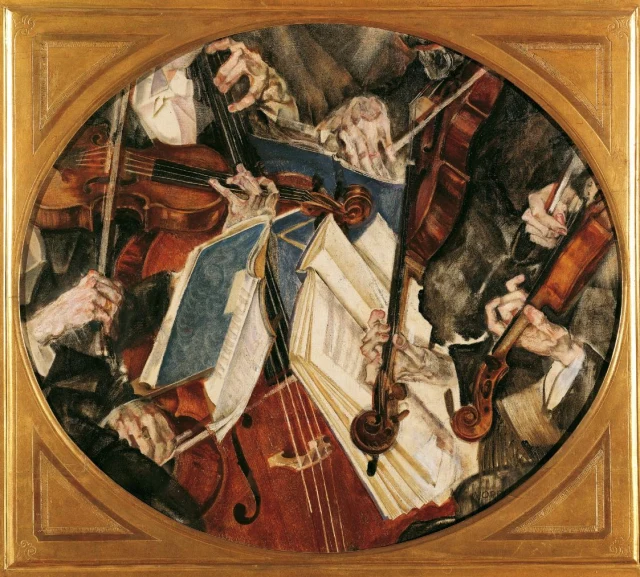
Oppenheimer was a keen violinist, and from about 1914 music became his main subject, with string quartets such as the Klingler Quartet of 1917. He was also in demand as a portraitist of writers and musicians, Thomas Mann and the composer Arnold Schoenberg among them. In 1926 he began a huge orchestra picture, first called The Concert, full of recognisable faces, with Gustav Mahler, the composer and former director of the Vienna Court Opera, conducting.
After the Nazi annexation of Austria in 1938 he fled, and in 1939 he shipped the panels to New York, where they were exhibited widely, including at the San Francisco world's fair. He kept reworking the picture until 1952, hoping to show it in Vienna. He died in New York in 1954, poor and largely forgotten. That same year the Republic of Austria bought the painting, three metres high and more than four and a half wide, and it now hangs in the Belvedere as The Philharmonic.