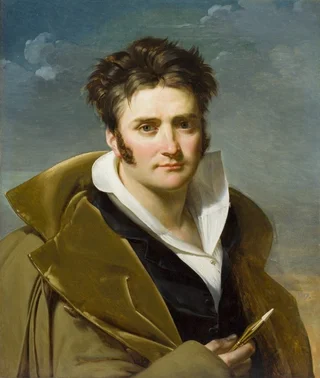
Merry-Joseph Blondel
1781–1853 · France · Neoclassicism
The story
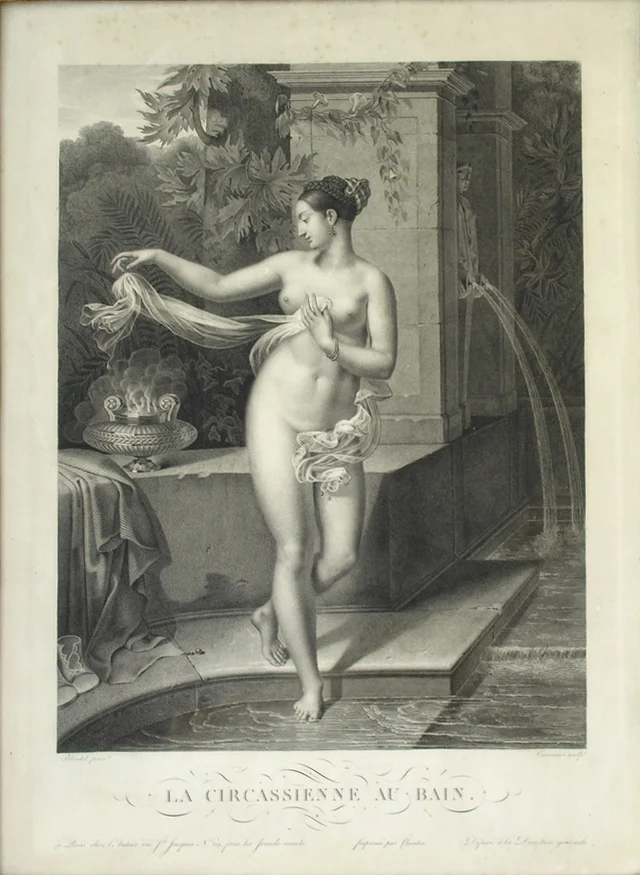
In January 1913, a Swedish businessman named Mauritz Björnström-Steffansson filed a claim against the White Star Line, the company that had owned the Titanic. He had survived the sinking by jumping into one of the last lifeboats. His luggage had not, and among it was a large painting he valued at 100,000 dollars, by far the most highly valued single item claimed from the ship. The picture was La Circassienne au bain, a young Circassian woman bathing, painted by Merry-Joseph Blondel almost a century earlier.
Blondel had shown it at the Paris Salon of 1814. By then he was a history painter of the Neoclassical school, trained in the studio of Jean-Baptiste Regnault and nicknamed Monsieur Cinq-Prix for the drawing prizes he collected there. He won the Prix de Rome in 1803 with Aeneas carrying his father out of burning Troy, but the Rome scholarships had been suspended, and he only reached the Villa Medici in 1809. There he met Jean-Auguste-Dominique Ingres, and the two stayed friends for life.
Much of his career went into ceilings. In the Louvre he painted for the grand staircase, the Salle Henri II and the rooms of the old Council of State, where France triumphs at Bouvines, a royal victory of 1214. At Fontainebleau he decorated the Gallery of Diana with scenes from the goddess's story. He was elected to the Académie des Beaux-Arts in 1832, and he was still working on frescoes for the Paris church of Saint-Thomas-d'Aquin when he died in 1853.