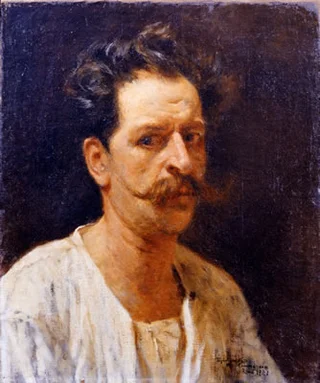
Michele Cammarano
1835–1920 · Kingdom of Italy, Kingdom of the Two Sicilies · Realism, History painting
The story
Michele Cammarano was 17 when his father died in Naples in 1852, leaving the libretto of Verdi's Il trovatore unfinished on his desk. Salvadore Cammarano was one of the busiest opera librettists in Italy, and his own father, Giuseppe, had been a painter in the city. The son enrolled at the Naples academy the following year and turned towards what was actually in front of him.
He learned that from the Palizzi brothers, Filippo and Giuseppe, naturalists who painted animals and country people at close range. In 1860, the year Garibaldi's volunteers took Naples, Cammarano joined the National Guard, and soldiers stayed in his work from then on. A stay in Florence brought him among the Macchiaioli, the Tuscan painters who built a picture out of blunt patches of light and shade, and a spell in Paris around 1870 brought him to Courbet. The canvases of those years are small and unheroic, among them a student who has failed his examinations, slumped on a rush chair in his top hat with his arms folded.
The battles came later and at state scale. In 1888 the Italian government commissioned him to paint Dogali in Eritrea, where an Italian column of some 500 men had been destroyed the year before. He sailed to Massawa on the Red Sea to see the ground and stayed nearly five years, painting the landscape and the people around him while he worked. In 1900 he took over Filippo Palizzi's chair at the art institute in Naples, and he painted little afterwards.