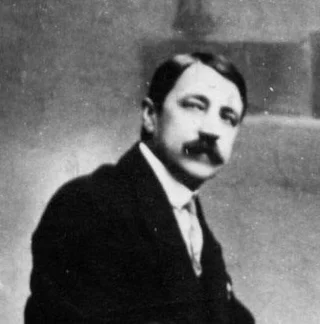
Mikhail Matyushin
1861–1934 · Russian Empire, Soviet Union, Russia · Russian avant-garde, Suprematism, Cubo-Futurism
The story
For about 30 years Mikhail Matyushin earned his living as a violinist in the Court Orchestra in St Petersburg, and only in middle age turned fully to painting and to the noisy new art rising around him. In 1913 he wrote the music for Victory over the Sun, a Futurist opera staged in a St Petersburg pleasure garden, with words by the poet Aleksei Kruchenykh and sets by the young Kazimir Malevich. One of Malevich's backdrops for it, a square divided into black and white, is where the idea behind his famous Black Square first appeared on a stage.
Much of his path he shared with Elena Guro, the poet and painter he married. Her death in 1913, at 36, cut short a partnership that had helped push Russian art toward Cubo-Futurism.
Afterwards he went his own way. Teaching in Petrograd, he developed a theory he called Zorved, from the Russian words for see and know, arguing that trained sight could take in far more than the eye usually reports, even the space behind one's head. He spent his last years on how colours behave together and published a colour handbook for artists in 1932, two years before he died in Leningrad.