Modesto Brocos Gómez
1852–1936 · Spain, Brazil · Realism
The story
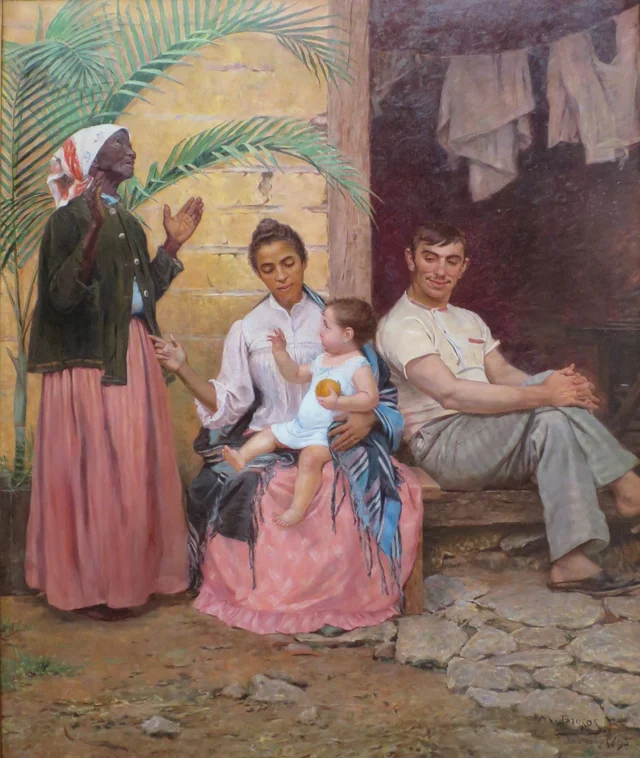
Three generations sit at a doorway in Modesto Brocos's best-known painting. A Black grandmother raises her hands to the sky, her lighter-skinned daughter holds a pale baby, and a white father sits beside them. Brocos called it Ham's Redemption, after the son of Noah whose descendants, in an old reading of the Bible, were said to be cursed. It won a gold medal at the national fine arts exhibition in Rio de Janeiro in 1895, seven years after Brazil abolished slavery.
In 1911 the picture was put to a new use. That year the physician João Batista de Lacerda, director of Brazil's National Museum, reproduced it in his paper for the Universal Races Congress in London, to illustrate his claim that Brazil would become white within about a century. Historians now discuss it as an image of that whitening ideology, and it hangs in the National Museum of Fine Arts in Rio.
Brocos himself was born in Santiago de Compostela, in Galicia, and trained first with his brother, the sculptor Isidoro Brocos. He crossed the Atlantic as a young man, first to Argentina and then to Brazil, and drew for a republican magazine in Rio to pay for classes at the Imperial Academy of Fine Arts. From 1890 until his death in 1936 he taught figure drawing at Rio's National School of Fine Arts.