Monkan-bō Kōshin
1278–1357 · Japan · Buddhist painting, Muromachi period art
The story
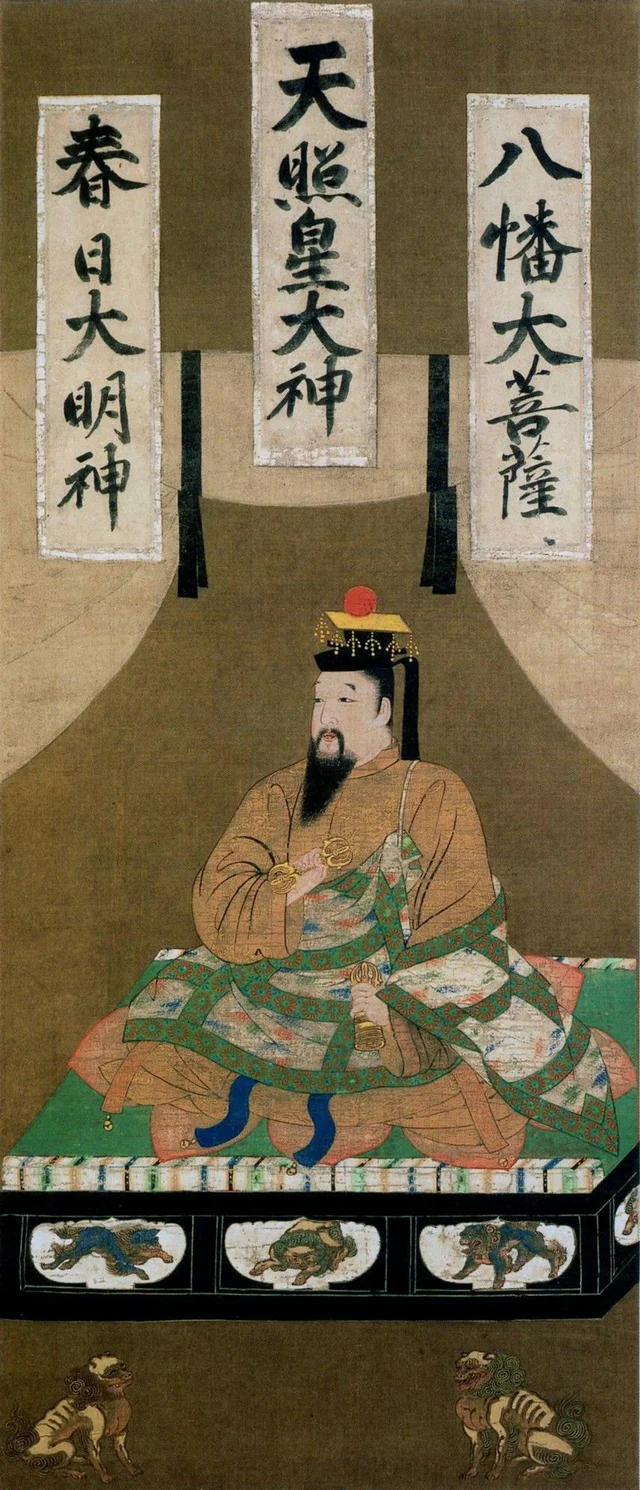
Monkan, also called Kōshin, is best known as a Buddhist monk deep in the politics of his day, and he appears among painters because of a single image made under his direction. Emperor Go-Daigo died in 1339 in the mountains of Yoshino, after failing to restore direct imperial rule over Japan. Monkan was his closest religious adviser, and within weeks he had a portrait of the emperor made on silk. Its eyes were ritually opened at a memorial service in October that year.
The painting shows Go-Daigo as Vajrasattva, a figure of esoteric Buddhism, holding a vajra and a bell and wearing two crowns at once. Three Shinto deities appear above him. Since 1396 it has belonged to Shōjōkō-ji, a temple in Fujisawa, and it is designated an Important Cultural Property.
Monkan belonged to the Shingon school, the main esoteric branch of Japanese Buddhism. In 1331 he was exiled to Iōjima, a remote southern island, accused of performing rites against the Hōjō, the family that controlled the Kamakura shogunate. He returned when the shogunate fell in 1333 and rose to head Tō-ji and Daigo-ji, two leading Shingon temples. Later chronicles painted him as a power-hungry sorcerer and linked him to the Tachikawa lineage, a branch accused of sexual rituals. Recent scholars suspect much of that reputation grew from his closeness to the emperor whose side lost. He died in 1357, at the temple of Kongō-ji south of Osaka.