Niccolò di Liberatore
1502 · Papal States · Umbrian school
The story
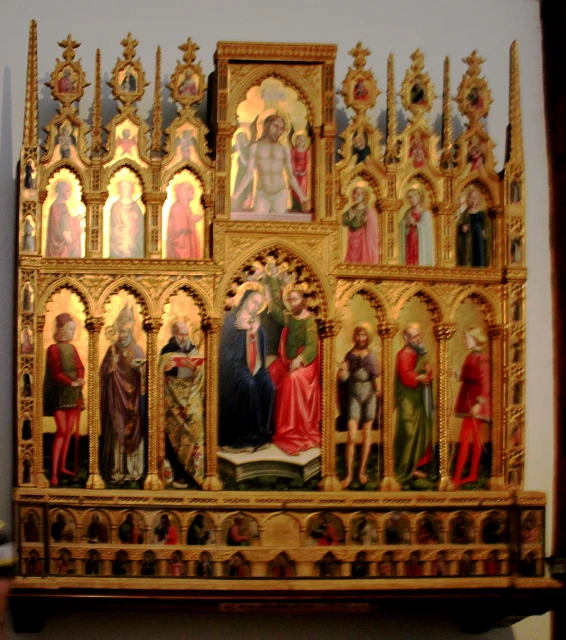
Most guidebooks call him L'Alunno, and the name comes from a misreading. On the altarpiece he painted in 1492 for the church of San Niccolò in Foligno, the Umbrian town where he was born around 1430, he signed himself Nicholaus alumnus Fulginiae, meaning Nicholas, a son of Foligno. Giorgio Vasari, the 16th-century biographer of artists, took the Latin word for a nickname, and it stuck. His real name was Niccolò di Liberatore.
He learned his trade in the workshop of Pietro di Giovanni Mazzaforte, a Foligno painter who became his father-in-law, and in 1465 the two were commissioned together to paint an altarpiece for Cagli. From Foligno he sent polyptychs and processional banners to hill towns across Umbria and over the Apennines into the Marche.
That 1492 altarpiece later travelled. Vivant Denon, director of Napoleon's museum in Paris, chose it for the Louvre in 1810, and in 1817 the sculptor Antonio Canova brought most of its panels back to Foligno. The predella, with its scenes of the Passion, stayed in Paris. In his last years his son Lattanzio worked beside him, and when Niccolò died in 1502 a Martyrdom of Saint Bartholomew was still unfinished, so Lattanzio completed it.