Niccolò Livaditti
1804–1858 · Austrian Empire, Principality of Moldavia
The story
Niccolò Livaditti left Italy because of politics. He was born in Trieste in 1804 into a well-off Greek family, took part in the Carbonari risings, the secret-society revolts against Austrian and Bourbon rule in the 1820s, and when those failed he had to get out. He reached Iași, then the capital of the principality of Moldavia, shortly before 1830, travelling with a troupe of French actors.
That is how the work started. From 1832 he was painter and stage designer for the Theatre of Varieties run by the Foureaux brothers, housed in a boyar's town house, and he painted its curtain with the muses. When a French company under Eugène Hette took the theatre over and enlarged it, he produced a second curtain, finished by 1840.
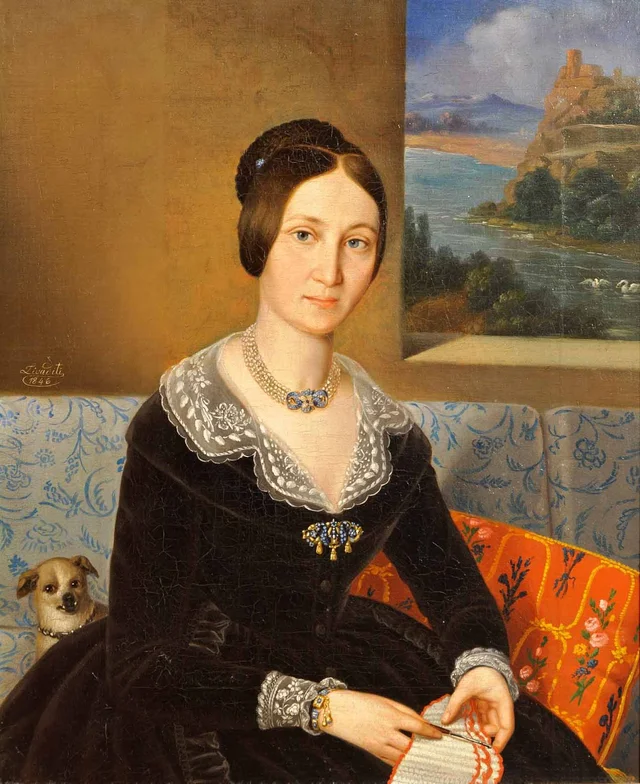
The portraits ran alongside. For 26 years the boyar families of Moldavia, the landowning aristocracy of the country, sat for him, and he gave Romanian painting something it had not had before, the group portrait with a whole family arranged inside one canvas. A Lady Working, painted in 1850, comes from those years and hangs in the National Museum of Art of Romania in Bucharest.
He is usually described as a naïve painter, meaning he arrived without a full academic training behind him. He trained local craftsmen in turn, and he stayed in Iași until he died there on 12 June 1858.