Nicholas Roerich
1874–1947 · Russian Empire · Symbolism, Theosophy, Modernism
The story
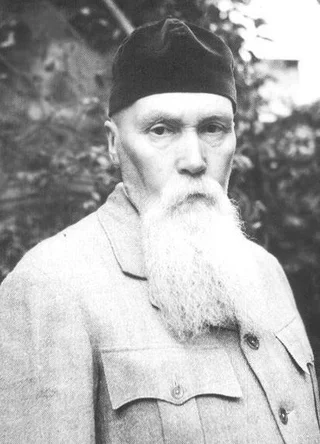
On 15 April 1935, in the Oval Office in Washington, delegates from 21 American countries signed a treaty proposing that museums, monuments and cultural sites be marked with a special flag and left alone by armies, even in wartime. It became known as the Roerich Pact, after the Russian painter who had spent a decade lobbying governments for it, Nicholas Roerich. He suggested the symbol for that flag himself, a white banner with three red dots inside a circle, which he called the Banner of Peace.
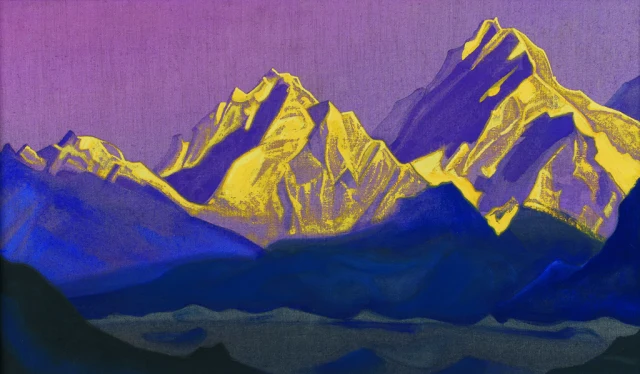
Roerich came to the idea partly from what he had just spent five years watching disappear. Between 1925 and 1928 he led an expedition with his wife and son across Sikkim, Tibet, Mongolia and the Gobi Desert, through territory where monasteries and manuscripts were being looted or destroyed in the chaos following revolutions and civil wars in Russia and China. He painted roughly 500 canvases on that journey, mostly the Himalayas rendered in flat, luminous blues and violets that owed as much to his interest in Theosophy and Eastern religion as to observed landscape.
The Roerich Pact was never widely ratified beyond the Americas, but it became the acknowledged precursor to the much broader 1954 Hague Convention on cultural property, which UNESCO still administers today.