Nicolai Fechin
1881–1955 · Russian Empire, United States · Realism, Portrait painting, American regionalism
The story
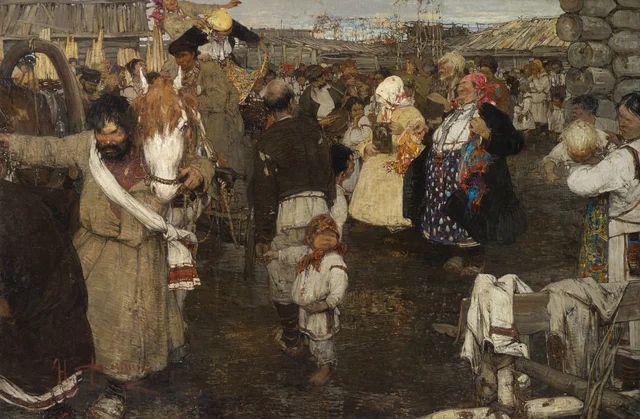
In the summers of 1906 and 1907 a young painter from Kazan, on the Volga, travelled to villages of the Cheremis, the people now called the Mari, and watched their weddings. The result was Bearing Away the Bride, a canvas almost three metres long in which a bride in white is taken from her parents' house among relatives and musicians, while the groom waits on a cart. Nicolai Fechin was then a student of the realist painter Ilya Repin at the Imperial Academy of Arts in Saint Petersburg. The picture won a prize there in 1908, was shown in Munich and at the Carnegie Institute in Pittsburgh, and stayed in America for about a century, until it sold at Sotheby's in 2011 and went back to Russia.
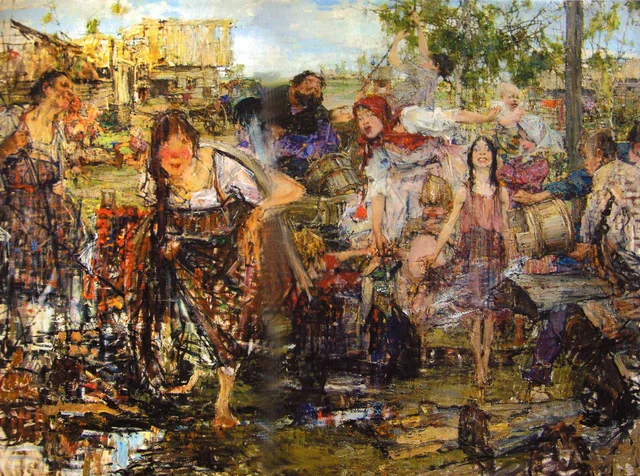
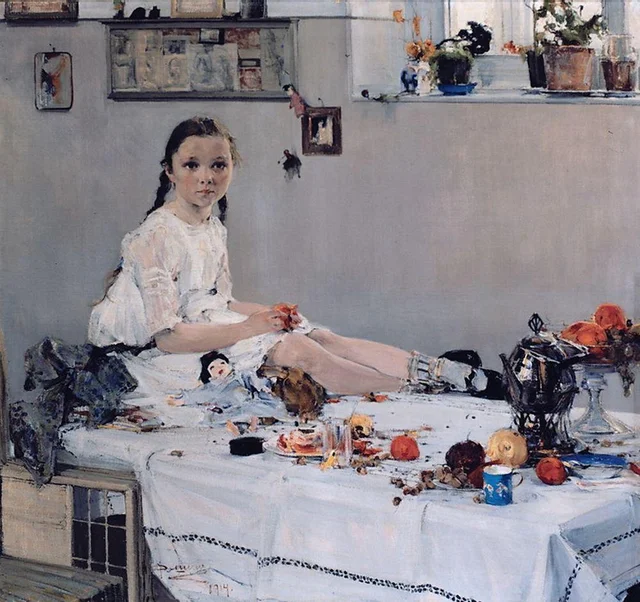
Fechin graduated in 1909 with a travelling scholarship and then taught at the art school in Kazan for about ten years. His large village pictures from that time include Pouring, in which peasants drench passers-by at a well, an old custom against drought. It was never finished and hangs in the State Museum of Fine Arts of Tatarstan in Kazan, which also holds his 1914 portrait of a little girl, Varya Adoratskaya.
After the hardships of the revolution he emigrated with his family to New York in 1923. Tuberculosis sent him to the dry air of Taos, New Mexico, around 1927. There he spent several years rebuilding an adobe house, carving its doors and furniture in a Russian manner, and painted the people of Taos Pueblo, the Native American town nearby. The house is now the Taos Art Museum. After his divorce in 1933 he left Taos for Southern California. He died in Santa Monica in 1955, and in 1976 his remains were reburied in Kazan.