Odoardo Borrani
1833–1905 · Grand Duchy of Tuscany, Kingdom of Italy · Purismo, Macchiaioli
The story
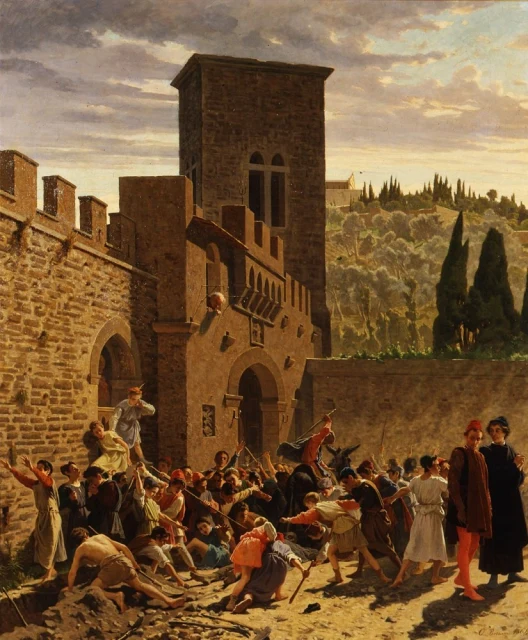
The subject Borrani took up in 1864 was nearly 400 years old and thoroughly unpleasant. After the Pazzi conspiracy against the Medici in 1478, Jacopo de' Pazzi was hanged, buried, dug up again and dragged through Florence, and Borrani painted the moment a crowd gathers around the body, the city walls rising behind them. Half the canvas is given to what lies past those walls, the green hills outside the city, painted the way he had learned to paint them in the open air.
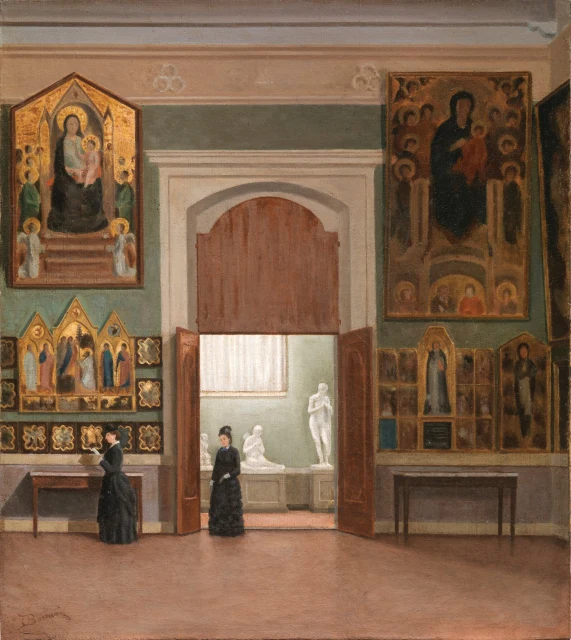
He had the training for a picture like that. Born in Pisa in 1833, he entered the Florence Academy in 1853 and worked alongside Gaetano Bianchi, the restorer who was then uncovering and repairing medieval frescoes in Santa Croce, which meant studying old painting at arm's length with a brush in hand. At the Caffè Michelangiolo he fell in with Telemaco Signorini, Vincenzo Cabianca and the rest of the group soon nicknamed the Macchiaioli, who wanted pictures built from blocks of light and shade seen outdoors. In 1862 he was out in the fields at Piagentina, just beyond the city, with Giuseppe Abbati and Silvestro Lega.
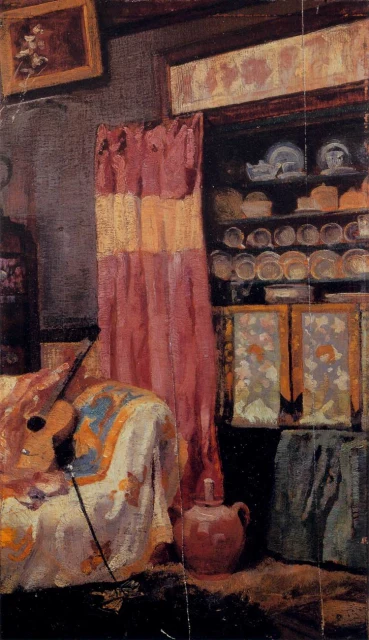
Later he exhibited less and made his living by teaching, decorating ceramics and drawing for print. In 1875 he and Lega opened a gallery meant to give younger painters somewhere to sell, and it closed about a year later. The other picture of his at Palazzo Pitti is a small panel called Lo studio, which the museum's catalogue sheet expands to interno di abitazione, the inside of a home. There is a sofa with a guitar lying on it, a red curtain with a yellow band, and a sideboard of coloured maiolica with flowers painted on its doors. The panel carries no date, and the museum puts it no closer than somewhere between 1850 and 1874, noting that the objects are set down summarily, in bright patches of colour.