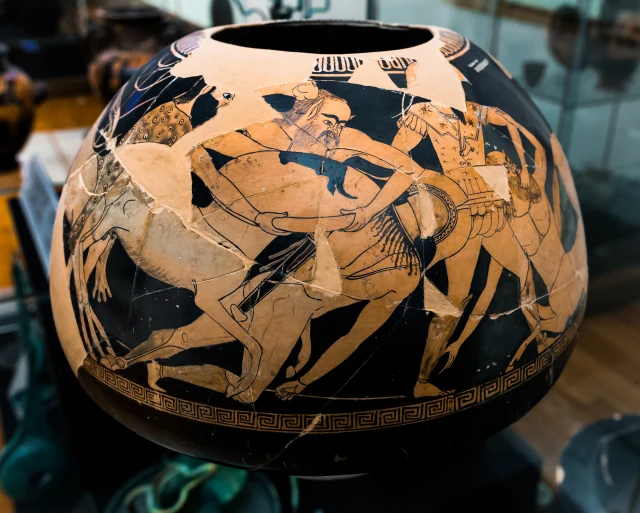
Onesimos
Ancient Greece · Archaic Greek art
The story
Around 500 BC Euphronios, one of the most admired painters in Athens, was working mainly as a potter, signing the cups he made with the word for "made". Several of those cups were painted by a younger man, Onesimos. One of them, now in the Louvre and found at Vulci in Etruria, carries both names, Euphronios as potter and Onesimos as painter, and that signature is how we know his name at all.
The name means "useful" or "profitable", and in Athens it was often given to slaves, though nothing tells us what his own status was. He worked from about 505 to 480 BC and painted almost nothing but drinking cups, filling their insides with solid, active figures, athletes, bathers, drinkers and heroes.
For a long time part of his work went under another name. The Oxford scholar John Beazley grouped a set of cups around the praise name Panaitios and called their author the Panaitios Painter, then came to see them as the early work of Onesimos. Most specialists now agree, though not all.
His most ambitious cup shows the fall of Troy, with Neoptolemos, the son of Achilles, killing the old king Priam. It was dug up illegally at Cerveteri, and the J. Paul Getty Museum in California bought its fragments in the 1980s, then handed them back to Italy in 1999.