Panagiotis Doxaras
1662–1729 · Republic of Venice · Heptanese school, Baroque
The story
In 1727 the church in Corfu that holds the relics of Saint Spyridon, the island's patron, hired a painter in his mid-sixties to fill its ceiling. Panagiotis Doxaras delivered 17 compositions in oil on canvas, set into the woodwork above the congregation and arranged like a Venetian ceiling, the figures foreshortened as if seen from below. A Greek church of that date would have expected gold-ground icons.
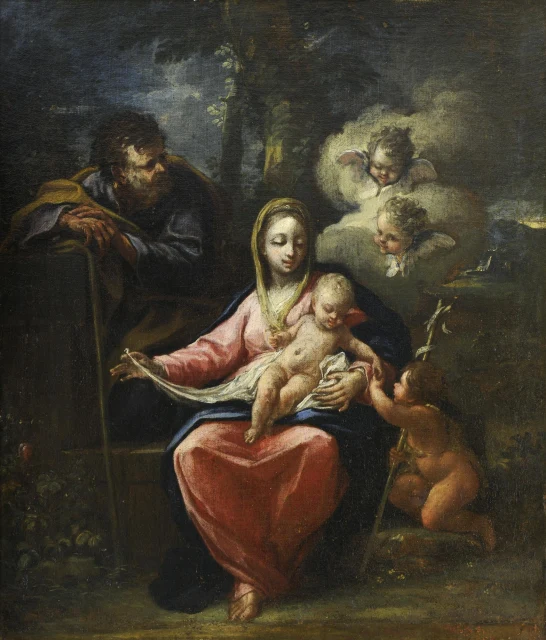
Doxaras had spent his life arguing for that change. Born in 1662 in Koutifari, a village in the Mani in the southern Peloponnese, he grew up on Venetian-ruled Zakynthos, where his family moved when he was an infant. Around 1685 he learned icon painting from Leos Moskos, one of the last masters of the Cretan school. In the 1690s he fought in Venice's wars against the Ottomans, and around 1700 he spent several years studying painting in Italy. In 1725 he portrayed Johann Matthias von der Schulenburg, the field marshal who had held Corfu through an Ottoman siege nine years earlier. That portrait is in the National Gallery in Athens, which also owns his Holy Family of 1700. His son Nikolaos became a painter too.
The argument itself went on paper in the 1720s as Peri Zografias, On Painting, the first treatise on painting written in Greek. He also translated Leonardo da Vinci's Trattato and other Italian writing on the art. The book told Greek painters to stop copying Byzantine models and study Italy, and it has been argued over ever since, partly because later scholars found how much of it came from those Italian sources. The manuscript waited nearly 150 years for a printer and appeared in 1871. The Corfu ceiling fared less well. Its panels decayed, and what visitors look up at now are copies, painted between 1853 and 1871 by Nikolaos Aspiotis.