Pauline von Koudelka-Schmerling
1806–1840 · Austrian Empire · Biedermeier
The story
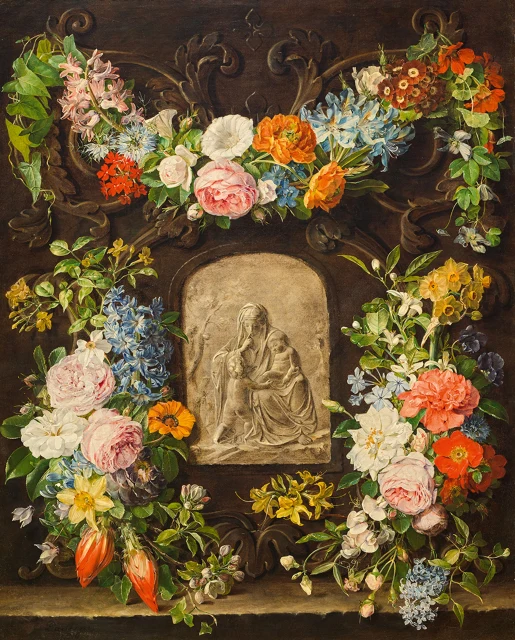
At the centre of her best-known picture sits a painted stone relief. Mary warns the infant John the Baptist not to wake the sleeping Christ child, and around that stone Pauline von Koudelka-Schmerling wound a garland of roses, hyacinths and narcissus. She painted it in 1834, and it is now in the Belvedere.
The idea was old. Flemish painters of the 1600s, Daniel Seghers among them, had framed religious images in wreaths of flowers, and Koudelka brought the form back in Biedermeier Vienna, the quiet, home-loving culture of the years before 1848. Born in 1806, the daughter of a general who was also a gifted amateur painter, she was taught first by her father, then by the flower painter Franz Xaver Petter, and was later influenced by Ferdinand Georg Waldmüller, the city's leading Biedermeier painter.
She showed flower pieces at the Vienna Academy exhibitions six times between 1830 and 1838, and the Austrian biographical dictionary calls her the most important flower painter of Vienna before 1848. In 1835 she married Anton von Schmerling, a lawyer who would later become Austria's minister of state. She died in 1840, five years after the wedding, at 33.