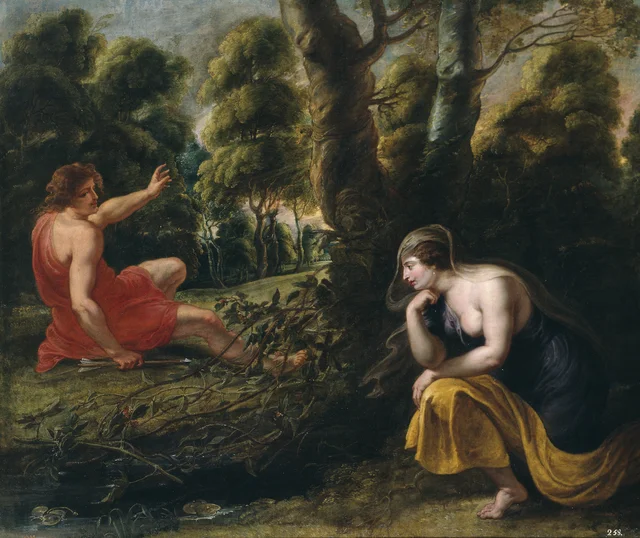
Peeter Symons
Southern Netherlands · Flemish Baroque, Baroque
The story
In 1636 Philip IV of Spain ordered a set of more than 60 mythological paintings for the Torre de la Parada, a hunting lodge in the woods outside Madrid, and gave the whole commission to Rubens. Rubens was approaching 60 and had two years left. He designed each subject as a small oil sketch and handed the full-size canvases to a crowd of Antwerp painters to carry out.
Peeter Symons was one of those painters. He appears in the records of the Antwerp guild of Saint Luke in 1629, registering as the son of a master, and is documented until about 1638. Almost nothing else about him survives. Neither his birth year nor the year of his death is known.
The canvas he produced for the lodge hangs in the Prado. It takes the story of Cephalus and Procris from Ovid, the husband who kills his wife by accident while out hunting, and for a long stretch of its history it was catalogued as a different myth altogether, Vertumnus and Pomona. Rubens built the figure of the dying Procris on a Renaissance source he knew well, Michelangelo's marble of Lorenzo de' Medici in Florence.