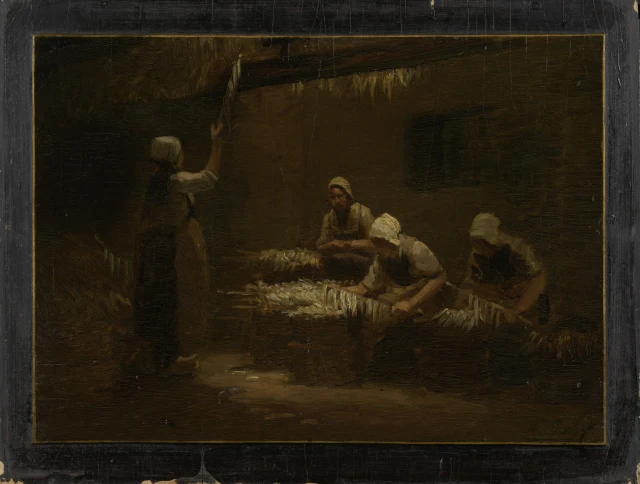
Philip Sadée
1837–1904 · Kingdom of the Netherlands · Hague School
The story
Painters who wanted fishing gear in a picture usually kept a few nets and baskets in a corner of the studio. Philip Sadée took a house in Scheveningen, the fishing village on the North Sea beside The Hague, and worked among the people there.
He had been trained for something else. From the age of 14 he was apprenticed to the painter Jacobus van den Berg to become a history painter, and he began with biblical subjects. The beach displaced them. Sadée was among the first Dutch painters to put fishermen and farm labourers at their work large in the frame, as the subject of the picture, at a time when figures in a Dutch landscape were mostly there to give it scale. His colour also stayed brighter than most of the Hague School around him, the group of grey-toned realists working near the dunes in those decades.
He exhibited in Amsterdam, Rotterdam and The Hague from 1853, when he was 16, until 1903, and he taught at the academy in The Hague, the city where he was born in 1837 and died in 1904. His "Herring Smokehouse" of 1878 is in the Van Gogh Museum.