Philippe Rousseau
1816–1887 · France · Realism
The story
At the Salon of 1867 Philippe Rousseau showed a canvas called "Chardin and His Models", which set the 18th-century still-life master at work in his studio among dead game and copper pots. It said plainly where his own painting had come from.
Rousseau had trained at the École des Beaux-Arts in Paris under Jean-Victor Bertin and Baron Gros, two academic painters, and he started out on landscapes. Animals and kitchen tables took over. The Salon medals came for the still lifes, a third class in 1845, a first class in 1848, a second class in 1855, and in 1852 he was made a knight of the Legion of Honour. The animal pictures let him tell stories, and in 1859 he painted seven scenes from the fables of La Fontaine, the 17th-century French fabulist, for the Hôtel d'Albe on the Champs-Élysées.
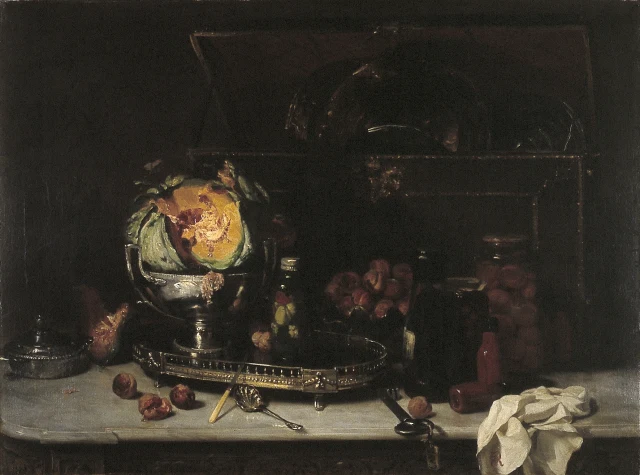
His "Still Life with Fruit" dates from 1841, early in that shift towards still life, and is in the collection of the Van Gogh Museum in Amsterdam.