Pierre Charles Comte
1823–1895 · France · Academic art, History painting
The story
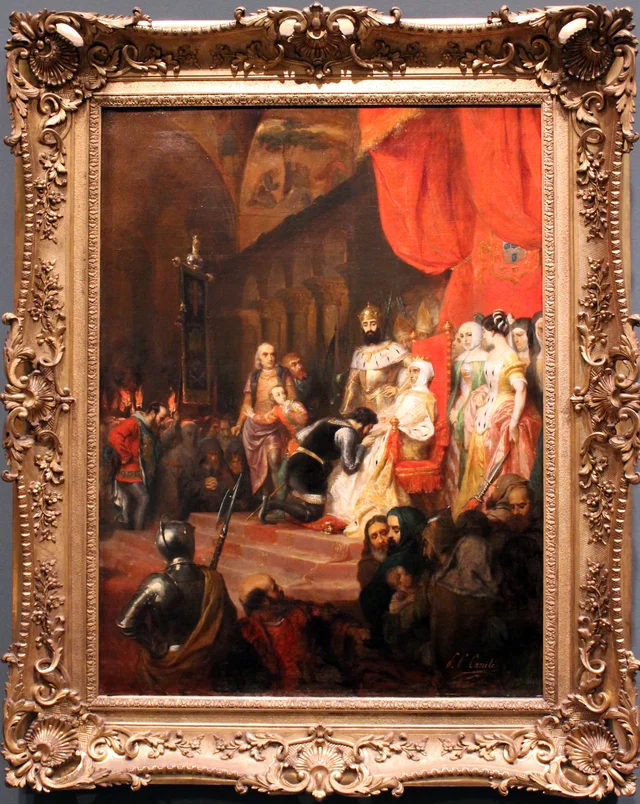
According to a Portuguese legend, King Pedro I had the body of his murdered love, Inês de Castro, taken from the grave, seated on a throne and crowned, and ordered his nobles to kiss her dead hand. Pierre-Charles Comte, a young painter from Lyon, chose that macabre scene for his second appearance at the Paris Salon, the great official exhibition, in 1849. The canvas has hung in the Museum of Fine Arts of Lyon, his home city, since 1885.
Born in 1823, Comte trained at the Lyon art school under its director Claude Bonnefond, and then in Paris in the studio of the history painter Joseph-Nicolas Robert-Fleury. He made his name with carefully staged scenes from French history, above all the court of the Valois kings in the 16th century. His Meeting of Henri III and the Duke of Guise, from 1855, is at the Château de Blois, the royal residence where the duke was murdered in 1588.
Salon medals followed in the 1850s, and he kept exhibiting at the Salon until 1887. After about 1875 his handling grew looser and more modern, and late in life he also made sculpture. He died in Fontainebleau in 1895, and a street in that town carries his name.