Pieter Balten
1584 · Habsburg Netherlands · Northern Renaissance
The story
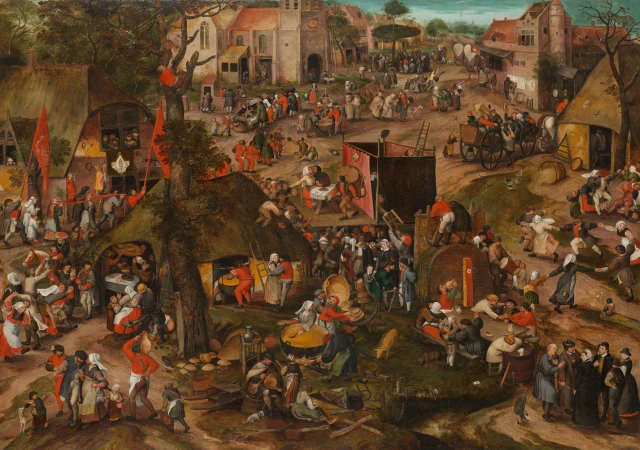
Around 1550 an Antwerp painter named Pieter Balten was at work on an altarpiece for the glovemakers' guild of Mechelen, a town just south of Antwerp. He painted the central panel himself. The wings, in grey monochrome, were painted by his assistant, a young Pieter Bruegel, long before Bruegel became famous for his scenes of Flemish peasant life. The altarpiece is lost. Because Balten was so clearly the senior partner, some historians now think the crowded village scenes that made Bruegel's name owe something to him.
Balten, whose name also appears as Peeter Baltens, led several lives at once. He engraved and published prints, dealt in art, and wrote verse as a member of the Violieren, the Antwerp chamber of rhetoric where citizen poets wrote and performed plays. The early biographer Karel van Mander called him a good poet. That theatrical side runs straight into his best-known panel, now in the Rijksmuseum, where villagers at a fair crowd round a makeshift stage to watch a farce.
Only about 13 of his paintings are known today, and not one of them carries a date. He died in Antwerp in 1584.