Pieter Gerardus van Os
1776–1839 · Kingdom of the Netherlands · Dutch Golden Age, Neoclassicism
The story
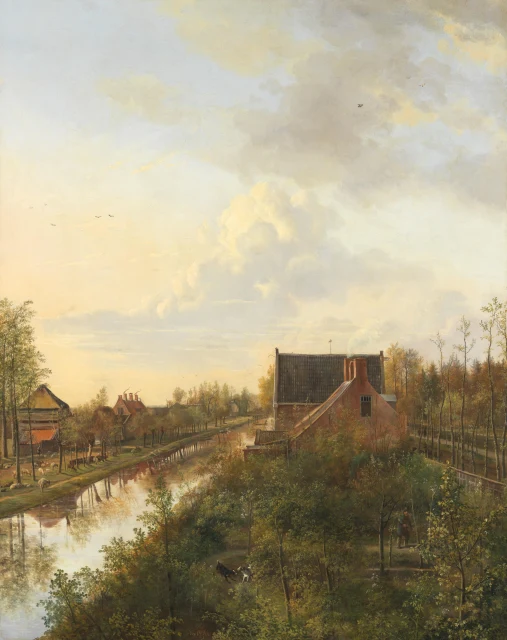
In 1817 an Amsterdam merchant, Herman Waller, asked Pieter Gerardus van Os for two views of 's-Graveland, the village of country estates east of Amsterdam where the painter was then living. Van Os went up to the attic window of Waller's country house and painted from there, looking down on the canal, the houses along its bank and the meadows beyond. When one of the pair, The Watercourse near 's-Graveland, was shown at the Amsterdam exhibition of living masters in 1818, critics found it more ingenious than beautiful. They disliked the high viewpoint and thought the subject too ordinary.
Van Os came from a Hague family of painters and trained with his father, the flower painter Jan van Os. His early model was Paulus Potter, the 17th-century master of cattle, and a copy he made of Potter's Young Bull was bought by the stadholder William V. In Amsterdam he earned his living with portrait miniatures and drawing lessons until, around 1805, he turned to landscapes with cattle. In 1808 one of them won the prize for the best landscape at the first public exhibition of contemporary Dutch art, a prize funded by King Louis Bonaparte, Napoleon's brother.
In November 1813, as French rule in the Netherlands collapsed, van Os served as captain of a local volunteer militia at the siege of Naarden, a fortress town still held by a French garrison. He drew and painted what he saw there without heroics or patriotic gloss. He died in The Hague in 1839. The Watercourse reached the Rijksmuseum in 1934, a gift from a descendant of Herman Waller.