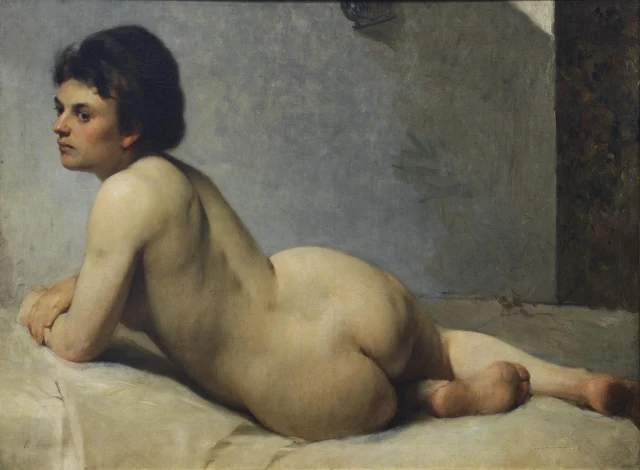
Polychronis Lembesis
1848–1913 · Kingdom of Greece · Munich School, Realism
The story
In 1911 the writer Pavlos Nirvanas went looking for a painter Athens had stopped mentioning and found Polychronis Lembesis at work on saints for a church. Three decades earlier he had been one of the best-trained painters in Greece.
He was born on Salamis in 1848 into a family of shepherds, and the money that got him to Munich came through the politician Dimitrios Voulgaris, who backed his scholarship. At the Munich Academy he studied under Wilhelm von Lindenschmit the Younger and Ludwig von Löfftz and kept company with Nikolaos Gyzis, the Greek painter already established there. He stayed until 1879. That was the road almost every ambitious Greek painter of his generation took, which is why their work is still grouped under the name Munich School.
Back in Athens from 1880 he lived near the Theseion, the ancient temple at the edge of the Agora, and earned his living from portraits of well-off families, the Dragoumis household among them, whose children he taught to draw. Later critics valued his landscapes most, Greek light handled with the loose outdoor touch that reached Greek painting in the last 20 years of the century. From 1883 much of his work was church commissions, including the Platytera at Agios Georgios Karytsis in Athens, the Virgin with her arms open and the Child at her breast. He left about 100 paintings, and when he died in 1913, in the middle of the Balkan Wars, the cost of his funeral was covered by selling pictures out of his studio for a few drachmas each.