Quirijn van Brekelenkam
1622–1668 · Dutch Republic · Baroque, Leiden fijnschilders
The story
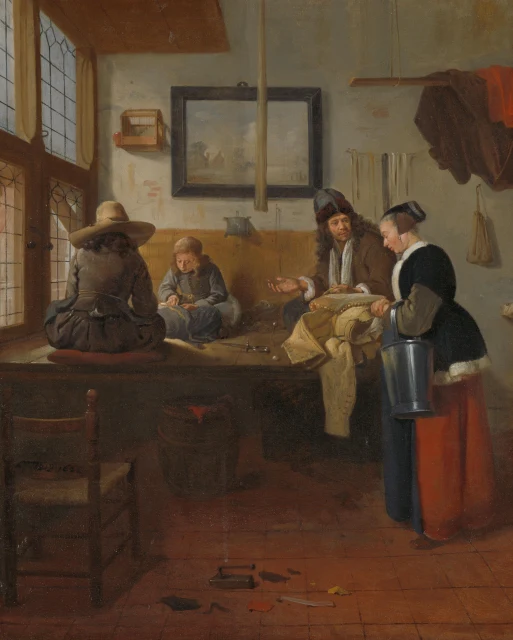
A woman with a market bucket on her arm stands in a tailor's workshop, deciding about a coat, while the tailors work on a raised platform by the window to catch the daylight. On the wall behind them hangs a small river landscape, a reminder that paintings were not only for the rich. Quirijn van Brekelenkam painted this scene in Leiden around 1661, one of roughly 25 tailor and cobbler workshops he produced between 1653 and 1664. He knew the trade from home. His father was a tailor in Zwammerdam, the village near Leiden where the painter was born around 1622.
Leiden then lived on cloth, and Brekelenkam kept returning to the people who worked it, tailors, spinners and seamstresses. Tradition makes him a pupil of Gerrit Dou, the city's celebrated painter of minutely finished small pictures. A document of 1646 does show the two men signing together, though the apprenticeship itself is unproven. In 1648, the year Leiden's painters set up their own guild of Saint Luke, he joined it, and that spring he married Maria Charle in a Catholic church.
They had six children before she died in 1655, and he had at least three more with his second wife, Elisabeth de Beaumont. Around 1656 he seems to have taken a licence to sell beer and brandy, often read as a sign that painting alone did not feed the family. Even so, 17th-century household inventories list more than 55 of his pictures, and some collectors owned as many as 18. The last trace of him is the baptism of his youngest child in May 1668.